

Benjamin Franklin (1705–1790): An Inductive Biography

Benjamin Franklin (1705–1790)
An Inductive Biography
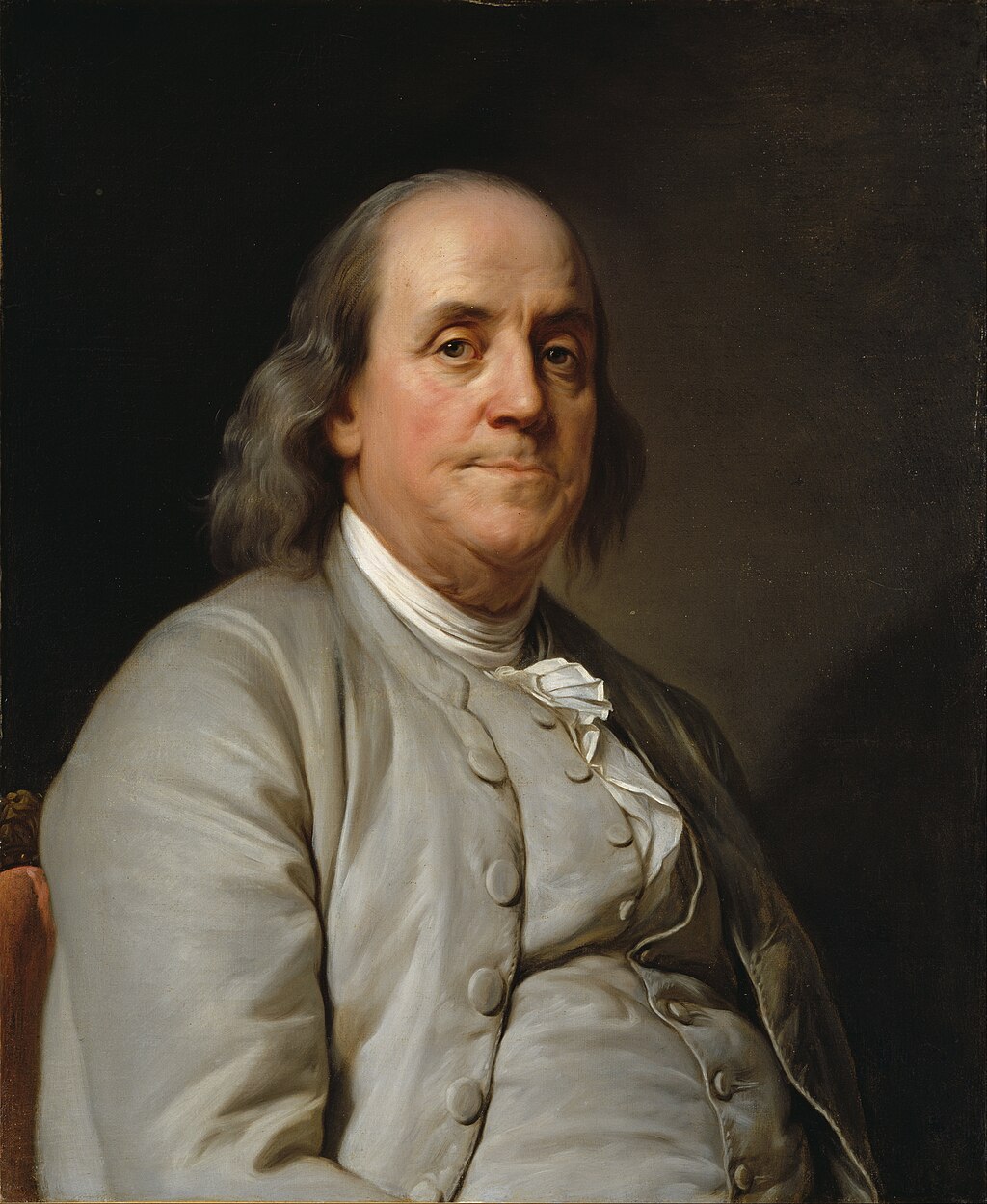
This article is one of six ‘Inductive Biographies’ which Eugen Kolisko wrote in 1938–39 for The Modern Mystic, immediately after his essay series on reincarnation. An ordinary biography moves forwards, from childhood to the individual’s contribution; Kolisko reads a life inductively — beginning with that contribution and asking what individuality, and what destiny, it reveals. Read this way, a biography makes a karmic perspective visible: a life shows itself as a task carried into the world. His contribution is twofold — lightning tamed and a republic founded — and Kolisko traces both back to a single faculty in Franklin: the schooled control of the will, in nature as in society.
The secret of Benjamin Franklin’s mission is contained in the words of Turgot: Eripuit coelo fulmen, sceptrumque tyrannis. He wrested the lightning from heaven and the sceptre from tyrants.
Lightning and Sceptre
Franklin was the discoverer of the mysteries of electricity, the spiritual founder of the United States of America, the great western forerunner of the French Revolution, and the father of the age of scientific enlightenment in the eighteenth century. He was equally great as a journalist, scientist, diplomat and last, but not least, he was one of the great leaders of Freemasonry.
A Self-Made Youth
He was born as the seventh child of his parents on January 17th, 1706, in Boston. His father, Josiah, a Presbyterian, was a candlemaker, who had emigrated in 1682 to New England to escape the religious suppression under the Restoration. His parents were wedded for fifty-five years.
Benjamin may be called a “self-made“ man. His education was very scanty, but he taught himself to read so early that he could never remember the time when he had been unable to do so. Books absorbed him from his earliest childhood. But he excelled also in all sports and games. At twelve he was apprenticed to his brother’s printing business in Boston, and quite soon he was the most skilful printer. The nights he devoted to reading and study: arithmetic, geometry, literature, travel-books, and his favourite Plutarch, and Xenophon’s Socrates.
His brother had been editor, since 1721, of the journal The New England Courant. Benjamin, who had to set it up, was anxious also to write for it, but knew that his brother would never have accepted any article from him. So he wrote them, nevertheless, in a disguised hand and put them in the “letterbox“ of the journal. To his great astonishment he found them afterwards selected for printing as being among the best received.
Before long his brother was involved in a law-suit which ended in his having to resign from his editorship, which he handed over to Benjamin, who was then about fifteen. But now he came into bad company, got into debt, and finally ran away to Philadelphia.
When he arrived there, without money, he got work at a printer’s called Keimer, who procured lodgings for him where he met a young girl, Miss Read. She was later to become his wife.
In the meantime his financial and other difficulties increased. But his charm attracted to him Governor Keith, who supplied him with the means for a voyage to England. He went to London, voyaging by the London Hope (1724), and remained there for two years. He was then twenty years old. in London he came into contact with a group of extreme young radical freethinkers, and wrote a pamphlet on materialistic Pantheism. “In a hundred axioms he proved that he knew neither sin, nor liberty, nor personal immortality. God was only permitted to exist as a machine.”/ So it is clear that he had quite severed himself from the orthodox puritan training of his childhood. In this comparatively short time, he became acquainted with most of the leading literary men of the day.
The Turning Point
At this time an incident occurred which was destined to be the cause of a complete change in him. He fell in love with the fiancée of one of his free-thinking friends, but she rejected his overtures. This, together with much else that he was experiencing, gave him a considerable shock; so much so that he determined to lead a different life. He burned the remaining copies of his book, and left London for Philadelphia, feeling as if he had escaped from plunging into an abyss.
During his voyage, he made a complete plan for his new life, and wrote it in his diary. The four rules he set for himself were to practise economy, perseverance, good-will, and loyalty. In economy: “it is necessary for me to be extremely frugal for some time, till I have paid what I owe. …” In perseverance: “To apply myself industriously to whatever business I take in hand… .” In Good-will: “I resolve to speak ill of no man whatever —not even in a matter of truth… .” In loyalty: “To endeavour to speak truth in every instance… .” Simplicity is the characteristic of this philosophy. His “conversion“ did not make him a Puritan in the old sense. He had “come of age,” and knew himself and also his God: “Franklin and his Supreme Being understood each other much more simply, without any fuss… .”/
Such a thing might happen to anyone; but in Franklin’s case the most amazing thing developed from it—a wider plan for self-education and discipline from which, with enormous willpower, he was to shape the pattern of his whole life, without intermission.
The Thirteen Virtues
This plan is, in my opinion, an occult document of great importance.
It consists of the practice of thirteen virtues: Temperance, Silence, Order, Resolution, Frugality, Industry, Sincerity, Justice, Moderation, cleanliness, Tranquillity, chastity, and Humility. [150]
“He made a little notebook for himself and ruled the pages, writing the days of the week at the top, and the virtues to practise down along the side. Each week he attacked a new virtue in particular, noting his faults and his failures, trying to avoid them, and making a clean sweep at the end of the week in order to begin the next one afresh. From week to week he went from one virtue to another until his final success. He always carried this little notebook with him and it held a great place in his life.”/
At first, he tabulated only twelve virtues; afterwards he added the thirteenth: “Humility; imitate Jesus and Socrates.”
He was twenty-one.
The Epitaph
At the same time he composed his own epitaph, and carried the little document about with him:
The Body
of
BENJAMIN FRANKLIN,
Printer, (Like the cover of an old book
the contents torn out
And stript of its lettering and gilding,
Lies here, food for worms.
Yet the work itself shall not be lost,
For it will, as he believed, appear once more,
In a new
And more beautiful edition,
Corrected and amended
By
The Author.
Not many people, I think, carry their epitaph (and such an epitaph) with them all their life. What does it mean? It means that he kept his death ever before him. This enabled him to live as he aspired to live—a very practical life indeed. And what is more, there is no doubt that this “epitaph“ hints clearly enough at re-incarnation. Without appearing to be too pedantic, I must take it quite literally: the “old cover“ is, of course, the body; the “work itself“ is not lost; but it re-appears in a “new edition,” so it must of necessity have a new cover; and if one adheres to the analogy, then the new cover must be a new earthly body … and the “work“ itself is “corrected and amended“ by the Author
However that may be, the Epitaph is another occult document.
An Initiate of the Will
Franklin was an initiate—of the will; a kind of initiation which we may consider to be especially characteristic for American humanity. And in this particular case it can be proved that every step of Franklin’s life was taken in accordance with this occult plan, and also with the spirit of the epitaph.
Certainly, if there is an initiation, there must also be an initiator. We find him in the quaker merchant, Mr. Denham. They met on the London Hope, and Denham became Franklin’s friend and adviser in all his London troubles and temptations, finally offering him work in his American business. They returned there together, now as intimate friends – Denham indicating to Benjamin the “path of virtue and utility.”
This Mr. Denham died, when both were taken ill in an epidemic that swept through Philadelphia in 1727. Franklin, too, was in danger of his life. And it was on his recovery and after Denham’s death that he finally developed his occult life-plan, his initiator in life becoming his inspirer after death. One would wish that all might find such a “Good Merchant“ as Mr. Denham!
The Junto and Poor Richard
The training of the “plan“ had two sides to it: one was for the inner life, the other for the outer life. The first outcome of the latter was Franklin’s founding of a “club“ composed of workers from the printing house of his old employer Keimer. It was called the “Junto.” “It was at the same time a social club, a study circle, and a moral organisation, resembling the Masonic Lodges and Chambers of Commerce of our day. A candidate for membership had to assure the club officials that he had no enemy among the members, that he loved humanity as a whole without distinction of religion, that he believed in freedom of conscience, and that he loved and sought liberty for its own sake.”/ This “Junto“ was really the beginning of an immense popular movement, but also there the occult foundation is easily to be found. Only we must learn to see that the “occult,” if genuine, is just the most “practical.”
“One evening, after he had dreamed over a book for a long time and fell in a quiet, contemplative and eager mood, he thought himself capable of shaking the world, and thus described his vision:
“’He may travel everywhere endeavouring to promote Knowledge and Virtue; by erecting and promoting private Liberty, establishing a society of Virtuous Men in all parts, who shall have an universal correspondence, and unite to support and encourage Virtue and Liberty and Knowledge by all Methods.’”/
And: “Franklin wanted to be the one who would perfect this doctrine and establish this society. In order to do this, he thought of writing ‘The Art of Virtue,’ which would be the moral code of the time, and he seized upon all occasions for the founding of this new knighthood. His ideas took their source from his readings, his meditations, his sufferings and ambitions, and very soon his project was as precise as a plan of battle. But to make his idea triumph was a matter of conquering the world. He needed, first of all, a group of men, organised as coherently as a political party, but without a party’s weaknesses.”
This task he fulfilled in the years 1727 to 1748. He had to begin from the bottom. The Junto with its library and lodge was a comparatively small circle. It was enormously extended through the publication of his Almanack. The Bible was in everyone’s hands; it provided for people’s spiritual needs. But the Almanack was designed to answer all the everyday worldly requirements of the population. In 1733 this sensational work appeared under the title of “Poor Richard: An Almanack containing the Lunations, Eclipses, Planets, Motions and Aspects, Weather, Sun and Moon’s Rising and Setting, Highwater, etc.: besides many pleasant and witty Verses, Jests and Sayings, etc… . By Richard Saunders, Philomath. Printed and sold by B. Franklin. Price 3s. 6d. per dozen.”
“Poor Richard“ was Franklin himself. And he was in this way giving instruction, through the Almanack, to countless people. Scientific progress, economical advice, how to gather wealth and prosperity, religious and ethical teaching, political discussions—all this was included in this unique publication.
In short, Poor Richard is, it seems to me, the first real expression of the truly American spirit. The whole idea of the “self-made“ man—practical, strong of will, self-educated, as pious on the one hand as scientific on the other hand—all this “incarnated,” so to say, at the psychological moment. And Franklin was the inspiring genius—literally for all Americans.
I am convinced that what really happened was that Franklin united two streams: the Quaker stream (of Penn) with the Freemasonic stream with which he had become acquainted in London. He balanced them in his own unique, self-controlled, and practical nature.
The political difficulties through which he had to pass in these times can also be characterised as a struggle to unite these two parties, the Right and Left. When he had achieved this, he was already famous. “Poor Richard“ had become the original autotype of the American people for the whole world.
The Electrical Discoveries
In 1748—in his forty-second year—a second phase of twenty-one years since his inner enlightenment had elapsed. Now his outer life was also established. The same year also marks the beginning of his great scientific achievements.
Franklin was always a “free-lance“ experimenter. He chose a few collaborators from among his neighbours, and the Almanack kept him in touch with others. He had no particular “axe to grind“ and so was tree to carry out his own ideas. Among his many interests and inventions (a catalogue of which reminds one of Christopher Wren’s—see Inductive Biography No. 1) electricity was the piece de resistance of his scientific life.
On the 7th of November, 1749, he wrote down in his notebook the fundamental principles of his ideas on electricity, He indicates twelve qualities which the electric fluid and lightning have in common—as follows :
- Both emit light
- The colour of the light
- The zig-zag form
- The speed of movement
- Conduction through metals
- Sound on explosion
- Penetration, unaltered, through water and ice
- Destruction of bodies through which they pass
- Killing of animals
- Melting of metals
- Fire-kindling property
- Sulphurous smell
“As they are so similar in these properties, why should not lightning be regarded as electricity ? Why not make the experiment?“
And this he proceeded to do!
In June 1752 he courageously sent up a kite (in the presence of his son) during a thunderstorm to see whether, with a key attached to it, it would really attract the lightning. To his great rejoicing, the key was found to be charged with electricity and a flash could be extracted. This was really an act of unique courage! and the news of it went over the whole of America and Europe like lightning itself. Franklin was now the hero of modern science. His experiment was immediately turned to practical use, and he himself fixed the first lightning-conductoror on his own roof. …” Prometheus had stolen a spark of the heavenly fire from the Cods and given it to man ; Franklin sought and found for the mortals of the earth protection from the tire of heaven.”/
Franklin was also the founder of the Academy of Philadelphia which is the foundation-stone of all the learned academies and societies in America. It is the American edition of the Royal Society in London. For those who have been able to recognise from Inductive Biography No. I that Sir Christopher Wren was the founder both of the Royal Society and of Freemasonry in England, Franklin must appear as his true “brother“ and successor in America, Wren died in 1723, and Franklin made his first voyage to England in 1724.
In this article we can only touch on the main events of Franklin’s life.
Ambassador in London and Paris
So we will now turn to his diplomatic mission in London. From 1751 until 1775 he was, with brief intervals, the Ambassador for the American colonists to the English Government. He made every effort to bridge over the differences between the two. He wanted autonomy for the colonists within the British Commonwealth. He seems to have foreseen what later became historical fact for the Dominions of the British Umpire. But he could not pierce through the stubborn and incredible narrowmindedness of the governmental views of that time. By the time the Civil War ultimately broke out, he had attempted every conceivable suggestion for reaching agreement. But in any case the destiny of the American States had to be fulfilled, and their independence had to arise. And so the great “representative American“ had in the end to return to his country when the War of Independence began.
Nevertheless, this was not his last mission. After the Declaration of Independence in 1776 he was elected by Congress to represent America in France.“ Just as .Abraham, at the age of seventy-five, left for Egypt, the wise old Franklin, now turned sixty-nine, prepared to leave for France.”/
This patriarchal visit was the culmination of his life. His reception in France—so often described—is hardly to be compared with any similar event in history. He was received by Parisian society as the “ Cod “ of the eighteenth century. There was no Frenchman who did not acclaim him: something essential in the nature of the two countries, awoke and embraced. Most interesting is the famous meeting between Franklin ant! Voltaire.
In a great meeting in the French Academy of Science the crowds insisted that Franklin and Voltaire should kiss each other á la francaise. The people applauded and wept and cried out how charming was this embrace of Solon and Socrates! On another occasion Voltaire, in a great assembly, put his hand in blessing on the head of Franklin’s grandson, with the English-spoken words: “Cod and Liberty!”
We may feel disposed to regard all this as rather theatrical, but Voltaire really was the representative of the Folk-Soul of the French people in that century. The two ”princes“ of the eighteenth century, American and French, had to meet as the “grand old men“ of their time.
Politically, what Franklin achieved in France was the official acknowledgment of the Independence of the United States—“the land of Liberty, Reason, and Nature,” was acknowledged by that country where soon the cry for Liberté, Egalité, Fraternité, would thunder over Europe.
Franklin and the French Revolution
This brings us to the connection of Franklin’s deeds with the French Revolution. In order to explain the background of this connection I feel I must quote somewhat at length from the classical History of Civilisation in England by Henry Thomas Buckle.
“During the reign of L. XIV the French, puffed up by national vanity, despised the barbarism of a people who were so uncivilized as to be always turning on their rulers, and who, within the space of forty years, had executed one King and deposed another. They could not believe that such a restless horde possessed anything worthy the attention of enlightened men. Our laws, our literature, and our manners, were perfectly unknown to them; and I doubt if at the end of the seventeenth century there were either in literature or in science, five persons in France acquainted with the English language.
“During the two generations which elapsed between the death of L. XIV and the outbreak of the Revolution, there was hardly a Frenchman of eminence who did not either visit England or learn English; while many of these did both. Buffon, Buissot, Broussonnet, Cardamine, Delisle, Elie de Beaumont … Helvetius … Lolande, Lafayette … Montesquieu, the celebrated Roland and his still more celebrated wife, Rousseau … Voltaire, all these remarkable persons flocked to London and also did others of inferior ability, but of considerable influence such as Bresceny … Vallient de Brieux (33 names).
“Nearly all of these carefully studied our language and most of them seized the spirit of our literature. Voltaire in particular devoted himself with his usual ardour to the new pursuit and acquired in England knowledge of those doctrines the promulgation of which afterwards won for him so great a reputation. He was the first who popularized in France the philosophy of Newton, where it rapidly superseded that of Descartes. He recommended to his countrymen the writings of Locke which soon gained immense popularity and which supplied materials to Coudillac for his system of metaphysics, and to Rousseau for his theory of education. Besides this, Voltaire was the first Frenchman who studied Shakespeare… .
“The works of Bacon, previously little known, were now translated into French and his classification of the human faculties was made the basis of that celebrated Encyclopaedia, which is justly regarded as one of the greatest productions of the eighteenth century.
“In the course of general reading I have met with proofs that the English language was known not only to those eminent Frenchmen I already mention, but also to mathematicians as d’Alembert… (to names), anatomists … (more than 100-130 names).”
This makes it clear that the French Revolution was caused by the injection of English Radicalism into the moribund autocracy of France. One could say that the powder for this European explosion was supplied from England through Voltaire: but the ignition was supplied by Benjamin Franklin:—the discoverer of: lightning-conductoror!—At this time there was really a political angle between France, England, and America. The two sides the triangle were united by a spark ; England, the base of the angle, escaped revolution. France presented America with Liberty. But the American Constitution, made in the spirit of Franklin, served as the basis for the French Assemblec Nationale.
Voltaire came to England in 1726—the same year in which Franklin left London to carry the same radical theories to Philadelphia which Voltaire had to carry to France. When they met at last in 1776, this process was complete.
Franklin lived long enough to experience—in America— the beginning of the French Revolution. His attitude is best described in the words from a letter of 1789. “A great part of the news we have had from Paris for near a year past, has been very afflicting. I sincerely wish and pray it may all end well and happy, both for the King and the Nation. The voice of Philosophy, I apprehend, can hardly be heard among these tumults.”
And it was not heard.
Nevertheless, when Franklin died, on April 17th, 1790, at 11 p.m., the National Assembly of France proclaimed a period of national mourning for three months throughout all the French provinces.
What Is Electricity?
I am convinced that Franklin’s discoveries in electricity and his political connection with that “elementary catastrophe” which we are accustomed to call the French Revolution, have not a mere chance relationship.
What is electricity? To my thinking it is a force which works also in the human organism, connected with the power of the human organism, connected with the power of the human will. It does not produce the will; but the will consists in controlling it. This, transplanted into the social sphere, control of will means control of revolutionary forces. There are always two alternatives in the social aspect: evolution through Reason; or, ultimately, revolutionary eruptions. Electricity is a power of profound mystery. It was only through Franklin that the progress of modern science came into contact with this power. But once it is unveiled, there is the problem of its control.
The electro-magnetic forces of the Earth form one whole; and as the magnetic pole happens to be situated in the north of the western hemisphere, America is most influenced by it. Therefore, it is not by chance that the spiritual founder of the United States is also the unveiler of the mysteries of electricity.
But I think that the last word of science about the true nature of lightning and thunder is not yet spoken. Franklin only discovered that side of it which is connected with the atmospheric electricity of the Earth. The cosmic aspect of this “heavenly fir “ escaped his grasp. That is why he invented the lightning-conductoror to save us from physical damage; humanity will not forget this.
But you never know what may not happen with this “mystery-force “ in the social life—not being controlled nor really understood, it produced Revolution. And we are still under the influence of this political cataclysm of the eighteenth century.
I propose to write more about these questions in my future articles on America, Past, Present and Future.
To seize the lightning is really the same thing as to seize “the sceptre from the tyrants”—that is, from those who have ruled the peoples through the ages; but the time came when this rule was bound to be taken over by the forces of the Individual. So the Rulers of the past became the Tyrants of the present.
- [Ed.] Section headings are editorial additions for the web edition; the original text runs continuously. Obvious scanning errors in the source have been silently corrected, a duplicated paragraph removed, and one printing-impossible date repaired (the Junto years 1727–1748); the author’s wording is otherwise unchanged. The PDF previously offered on this site broke off mid-sentence; this web edition restores the full ending from the original document.