

Destiny Learning: A Way of Meeting Destiny as a Learner

Destiny Learning
A Way of Meeting Destiny as a Learner
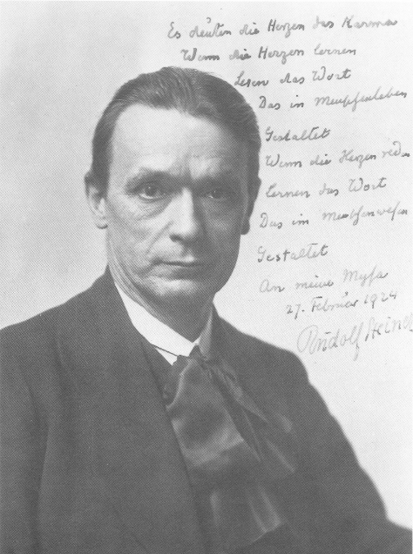
Our hearts sense the meaning of Karma
When our hearts learn
To read the word
That forms creatively
In human lives,
When our hearts learn
To speak the word
That forms creatively
In the human being.
For my Mysa
27 February 1924
Rudolf Steiner
Rudolf Steiner, Verses and Meditations, CW 40, p. 308 — written for Ita Wegman on a photograph, on his 63rd birthday.
Where does a déjà-vu come from? For the author, a summer journey in 1976 turned that question into a search, which led him to biography work and to Coenraad van Houten’s Destiny Learning. This article introduces the three ways of learning and walks through the seven steps by which a group works on a destiny incident — one participant’s process serves as a running example, and the article closes with the two Steiner verses that have carried the work since the 1990s. The photograph above bears the first of them, in Steiner’s own hand.
Déjà Vu – Seen Before
Déjà vu experience, according to Duden Lexikon (German, 1968 edition) is a memory illusion, the impression that an experience or an incident one is currently experiencing has already been experienced in the past.
Déjà-vu 1976 – That summer I went on a long trip. In the north of Scotland I felt strangely touched as I went along a country road towards evening. A feeling arose within me that was completely out of the ordinary: ‘You have been here before. You know the vegetation, the hills, and the way the sun is setting.’ I had an idea as to how the road would go on, yet I was sure I had never been in that place before. Where did this feeling come from? I had never been in that kind of landscape before. This was crazy! The next thought, was even crazier: Was it possible that we did after all have several lives on earth? Do I know this place from ‘another time’?
The question had come up spontaneously. Other, more and less intense experiences during that summer trip made it so acute that the whole view I had of the world, based on natural science, material things and Marxism, was shaken to its foundations.
For me, this was the beginning of a search for anything that might enable me to discern clearly experienced memories welling up as images from false memories or possibly delusions. At the same time I felt the need to bridge the gap between my rational present-day thinking and undeniable experiences which seemed irrational.
The search led me to discover Biography work and Destiny Learning. From 1992 onwards I worked with Coenraad van Houten and later with other colleagues to further develop the destiny learning process.
Three Ways of Learning
The concept of Three Ways of Learning originates with Coenraad van Houten1. His research into human learning biographies, adult education, biography work and modern ways of spiritual research led him to distinguish three ways of learning:
- Learning for life. School learning or any kind of learning in a formal learning situation as found in all educational institutions. Skills and abilities for work, everyday life, or for personal development are taught by following a curriculum designed by a qualified person.
- Learning from life. Looking closer at ‘Learning for life’ settings leads to the insight that aside from engaging with the course content, participants learn almost as much from meeting each other, their different life experiences, skills and being challenged by constantly changing life situations around them. In addition to the designed curriculum a second, a circumstantial or life learning curriculum is in place. ‘Obstacles’ which manifest as if from outside in our social, material or natural environment provide constant new learning opportunities. Sometimes it appears like a connection which logic cannot explain between myself and the obstacles that arise for me. It’s as if the obstacles know my details.
If this ‘learning from life’ could be seen as a curriculum, the design must have evolved at a time before birth, in a spiritual pre-existence, with my involvement and for my further development during my upcoming life.
- Learning from the spiritual world. This comes from the spiritual dimension of man. What we learn when we start to resonate with spiritual questions or facts; coming to us sometimes as a déjà-vu experience. This may lead the attitude of wanting to explore the more subtle or spiritual aspects of life phenomena, and in due course to pursuing an individual path of inner development.
Learning from Life or Destiny Learning
The idea of Destiny Learning again was developed by Coenraad van Houten2 and first published in his book on adult education Awakening the Will. Coenraad van Houten discovered that the seven life processes are the archetype for every adult learning process. In the first three seven-year periods (three times seven years, from age 0 to 21 the seven life processes predominantly serve the development of the organs and the human body. From the 8th year onwards they increasingly also serve the individual for learning and personal development purposes. Coenraad van Houten builds on Bernard Lievegoed’s intense exploration of the Life Processes in connection with influences from the seven Planets visible for the naked eye.3
The table below shows the Life Process as the archetype in column 1, the Adult Learning Process in column 2 and the Destiny Learning Process in column 3. The process of learning from the spiritual world is not included.
| Life processes Archetype |
Learning processes First derivation |
Destiny learning process Second derivation |
|
|---|---|---|---|
| 1. | Breathing | Observing | Observing / perceiving a destiny incident |
| 2. | Warming | Connecting | Connecting to one’s biography |
| 3. | Nourishing | Digesting | Contextualising a destiny incident |
| 4. | Secreting | Individualising | Self-appreciation – accepting one’s destiny |
| 5. | Maintaining | Practising | Practising destiny awareness in daily life |
| 6. | Growing | Developing | Developing organs to perceive destiny |
| 7. | Reproducing | Creating | Creating order in destiny – ordering destiny |
The ‘Destiny Learning’ Process
The work begins like a biographical sharing. One member of a Destiny Learning Group prepares to narrate an incident of his life. Several others listen with open mind and heart. The incident should not be supersensible by nature, should have happened after the 18th year and no longer have a great emotional charge.
Step 1: Observing / Perceiving a Destiny Incident (Breathing – Observing)
A (destiny) incident is selected, individually prepared, narrated and taken in by a group of listeners. It is essential to objectively present sensory impressions, emerging feelings and upcoming will impulses. Firstly the outer aspects are described as seen through the lens of a camera, including all sensory impressions and facts that can be remembered.
Secondly the inner aspects are added, feelings, impulses to act and thoughts gone through during the incident. The groupwork aims to bring out particularly characteristic reactions and qualities. A Gesture (pattern) typical of this individual and this incident emerges. What is the narrator’s individual way of dealing with the incident? Many people miss their trains, but everyone reacts to this in their own way.
The work is accompanied by art and observation exercises which support the steps of the process. Participants are also encouraged to try the Four-Day Karma Exercise4 with the most important image of their incident.
The narrator can decide at any moment in the process if he wants to go on. This learning process calls for the ‘I’ to be consciously and willingly engaged. It is not part of a Destiny Learning process to act as a karma-oracle or to list the last five incarnations of Mr Miller. The ‘Who’s who’ interests Mr Miller above all, if he thinks he was Napoleon and is now looking for confirmation. The latter is not our concern, as it does not contribute to karmic-insights based on thoughtful exploration and ‘practical and karma exercises’.
Viola tells the others about something which happened when she was taking an exam. In the weeks preceding the exam she had to divide her time between social commitments and study. On the day of the exam obstacles had to be overcome on the way to the examination centre. When a practical demonstration was required of something she had so far only considered in theory there came a moment of absolute uncertainty, helplessness and powerlessness. ‘I am done for!’ went through her head. I am not prepared for this.’ ‘I have been learning this the wrong way.’ At the same time she was aware of two things with equal intensity: fear of failure and fear of losing face. She panicked and could no longer think clearly. The examiner ended the exam saying that he had expected more of her. (She did pass!)
Step 2: Connecting to One’s Biography (Warming – Connecting)
The narrator looks for incidents of similar quality and characteristics in his or her biography. The similarities do not have to be logical but qualitatively or with a sense of inner connectedness compatible. The following questions will often help build a bridge to similar life incidents: Are you familiar with this feeling? Where from? (Feeling Bridge) Do you remember similar incidents? When did something similar happen for the first time? (Incident Bridge) The two bridges help to connect the initially shared incident with similar life situations.
The law of karma indicates that individualities who lived and acted on earth will stay connected with the results of their deeds. These results will come back to them seemingly from outside, as facts, tasks or resistances in a later life. During a spiritual existence between lives on earth individualities will, according to their level of development, predetermine an instrument (body) with a specific inner nature (soul) for their next incarnation. In a next incarnation the instrument and inner nature (Instrument Karma or how I am built and tuned) resonate with specific outer incidents, which seem to know my details, as they are probably results of my deeds in a previous life (Incident Karma). Two streams of karma meet, Instrument and Incident Karma, and the learning is in becoming mindful of how I conduct myself at the crossing point.
Patterns are looked for in destiny learning. Unsuccessful patterns have proven to be particularly interesting starting points. We tend to repeat successful patterns, but it is rewarding to study what happens where and when we repeat unsuccessful patterns. With the help of the group a Gesture (pattern) was pealed out in the first step of the process. This second step aims to fine-tune the Gesture. To conclude step 2 we aim to collect only the key elements, key qualities or a phrase as a representation for the essence. Writing this down is helpful for anchoring and later fine-tuning.
Possible digressions consist in failure to find one or more other examples of similar quality or death by detail.
When the qualities of an incident have been clearly established it may happen that the individual suddenly discovers a whole network of cross linkages. ‘If it is this, it will be the whole of my life.’ Now one has to be careful not to trawl endlessly through one’s biography without arriving at karma.
Viola told the others that she had rediscovered the gesture (pattern) from Step 1 in certain situations at work. She was asking a lot of herself, wanting to achieve perfect results and do as promised. It will then happen that numerous minor things pile up and become an excessive burden. One little thing may then be the last drop and make the water flow over. The something says ‘Stop’ in her. She loses her powers of memory for a moment, the ability to think, establish order and system. Other people are not aware of this. Viola fills her time with simple mechanical activities, tidying up, etc. Dominant feelings are the fear of failure and fear of proving inadequate. She is particularly worried about losing her memory and orientation for good.
Step 3: Contextualising a Destiny Incident (Nourishing – Digesting)
Work continues on the gesture (pattern) or essence which is reflected in the incident, initially asking the narrator ‘How did the result we arrived at yesterday develop overnight?’ Then all the mosaic stones found are brought together. It will be here at the latest that one sees the value of careful observation and of the notes that have been taken. Records must be kept and clear ideas gained to practice ‘spiritual science based on the method of natural science’.
We continue in three rounds
- Sharing ‘origin-associations’ or imaginations. – The members of the group offer images of past situations which have arisen as counter images to the incident in their minds. The following key questions may prove helpful in this:
- Can you think of a historical or social situation in which the gesture (pattern) of the narrator, a gesture of dissonance with things today, might have been right or (vitally) important?
- Where, in what way or in which kind of situation might it have arisen or become ingrained by repetitive practice?
The narrator listens and considers things in his or her heart. What touches me? He or she will only give feedback at the end of the round unless something happens that is utterly intolerable. Also at the end the narrator shares her or his own imaginations.
- Synthesising and analysing. – Having received the narrator’s feedback and contribution the group will enter into conversation aiming to condense into an overall picture the images, parts of images, sentences or words which the narrator had found compatible. The narrator listens and enters in, when an origin-image emerges that resonates strong or ‘true’.
- Forming an essence. – Group and narrator work together to gain an essence derived from the narrator’s resonances and as many as possible of the mosaic stones found in steps 1 and 2. Anything which does not fit the emerging origin-image gets noted and deliberately put aside. It might be of use in another process or if the origin-image needs adjustment.
How Does This Method Differ from Free Association and Wild Speculation?
Firstly the starting point: Careful observation, presenting the facts of an incident as perceived with the senses and the resulting thoughts, sensations and impulses to act. The following question must be answered for every statement made: How does this relate to the incident? This need not be logical, nor psycho-logical but coherent.
Secondly it is not the narrator who offers images of a past situation but the listeners, though they know nothing about the narrator’s possible affinities with certain historical situations or indeed figures. The narrator uses his sensing (feeling with the heart) to see if there is something which rings a faint bell or triggers an overwhelming spontaneous reaction; both tend to happen in this third step of the process.
In his Reincarnation and Karma5 Rudolf Steiner distinguished a conceptual memory and an emotional memory. Concerning the former he indicates that it is more or less limited to the present incarnation. Concerning the latter he wrote, ‘As we have now heard, the first impression of the earlier incarnation comes as a direct memory in the life of feeling, as a new kind of memory’. … ‘Something that is like a feeling arising in an act of remembrance is what comes to us as a first impression of the earlier incarnation.’ (p49) He continued, ‘How can one know that the impression is actually a recollection?” There it can only be said that to ‘prove’ such a thing is not possible. But the process is the same as it is elsewhere in life when we remember something and are in a sound state of mind. We know there that what arises within us in thought is actually related to something we have experienced. The experience itself gives the certainty. What we picture in the way indicated gives us the certainty that the impression which arises in the soul is not related to anything that had to do with us in the present life but to something in the earlier life.’ (p50, 51)
Learning from destiny does not always lead to a break-through, but when the seemingly impossible does happen the group will be able to sense this as an atmosphere in the room and the narrator will inwardly know it as evidence. ‘I do not like it. It is unexpected; it is not good, not logical, but there is some truth in it.’
One will often be aware of three time streams intermingling
- A stream from the past, from a past incarnation, which partly gives the incident its character.
- An element belonging to the present, with an unconscious part (the shadow or double) connected to the narrator’s personality interfering in the incident. Others will often soon identify this ‘shadow’ part, the individual concerned often grasps this part only indirectly by looking back on his actions and their effect on others.
- A developmental challenge or some potential for the future. This comes when the narrator discovers how destiny elements may become learning elements.
Recognise and accepting the challenge of one’s own destiny can release considerable reserves of energy. My experience is one of freely and harmoniously being in tune with the Curriculum of the Spiritual World; there are days when even the timing of traffic lights and underground trains seems to be in accord with that inner rhythm. You are in tune or find that you are ‘in the flow’.
The members of the group offered widely differing images to Viola. – A healer who had failed and must not admit his error or he’ll be in danger of his life. – A blind person who had access to his environment and to nature but was always coming up against the limits set by his blindness. – A medieval market place. A journeyman who did his craftwork with much love and devotion. He was member of a guild, had successfully gone through a number of tests, but somehow was unable to achieve the grade of master craftsman.
The image of the guild rang a bell. ‘It did touch me deeply when you said that.’ The members of the group were then talking about possible reasons for not achieving the grade of master craftsman. Because of him being wrongly assessed, cheating or some kind of handicap. The image of the blind man was taken up. At first Viola listened in stricken silence. Suddenly she interrupted: ‘It wasn’t the eyes. It was an accident. It was the hands or the arms. It is as if I’d no longer be able to hold my tools. ‘I am done for. I can no longer do my work.’ The conversation then concerned the social and vocational consequences for the journeyman. He was now unable to achieve the aim he had worked towards with such devotion. Someone spoke of the infinitely powerful longing which may have remained to produce that masterpiece. Viola was surprised but felt that the group work process and the possibility which had emerged were in accord with her memory. It was enough for the day and she wanted to sleep on it.
Step 4: Self-Appreciation – Accepting One’s Destiny (Secreting – Individualising)
Having been very active in asking questions and making offers during Steps 2 and 3, the members of the group now step back. Secretion, individualisation, marks the change from periphery to point. The question now is if the narrator has been so much touched by something which had been found that he or she is truly able to make it his or her own. Confrontation with the self becomes a piece of profound self-knowledge and leads to self-appreciation.
Karma is the reality in which we live. Grasping this could be an opportunity for us to wake up and see how the present is growing progressively more illusory and know its problems. Just think how much illusion would be overcome if we were to speak as openly about money, income and needs as we are increasingly doing about the most intimate sexual affairs. Think how much light could arise among individuals working in the social jungle if every-one of them was able to find ‘his place’ through mutual insight concerning past karma and the present gifts and challenges.
In step 4 as well as in all other steps the group must refrain from ‘well-meant advice’, judgment and moralising. A different way of looking is required. Being judgmental or moralising proved counterproductive in the Destiny Learning process. Today’s serious crimes may have been the most sacred obligation in past civilisations. (This is not meant as an excuse for the brutalisation we see today.)
The next day Viola told the group that she wanted to stay with the journeyman who was learning to be a master craftsman, but found he could no longer hold his tools and this was the end of his world for him. Further conversation about the barriers and a possible challenge to learn something yielded an additional element. Fixation on a particular chosen path means that one is no longer looking to the left or the right. Hence the ‘I am done for.’ Someone then said ‘So everything you do now has to be a masterpiece!’ That seemed to hit the nail right on the head, first taking everyone aback and then leading to general laughter. Inwardly the ‘endeavour to produce a masterpiece’ is a block enforced by outwardly being ‘unable to look to the left or the right any more’. It became clear how this impacted on the exam: Inwardly striving for the masterpiece and when asked to do something, ‘disabled by karmic-memory’ to perform at her best.
Step 5: Practising Destiny Awareness in Daily Life (Maintaining – Practising)
Group and narrator work out under what conditions the shadow brings about or adds something unintended and unforeseen. They decode the ‘dramaturgy’ including the ‘invisible stage director’s commands’ in the incident. Does it always happen when there is one other person present? Does a technical object always play a role? Does it always happen in front of groups? Are the children always involved?
The aim is to understand the challenge, for learning something, to coming awake whenever the pattern recurs in everyday life and transforming a bit of the double, by taking small steps. A special painting exercise and suggestions from the group support this step.
Viola would like to change, reduce the demands she is making on herself. Not take on everything which comes to her from outside. The group suggests to remember that not everything you do has to be a masterpiece.
Step 6: Developing Organs to Perceive Destiny (Growing – Developing)
When we work with destiny and the shadow, does this create an organ for recognising destiny? People who have gone through several Destiny Learning processes report that they begin to be more awake in experiencing destiny related challenges. They speak of distinct inner experiences such as ‘Don’t do it yet, the time is not yet ripe.’ ‘If I do that, the consequences will be ….’ They are more relaxed in going through trials of life (‘… what will be will be …’) or intervene with a certainty they had not known before.
Viola and the group look for elements that may serve as an early warning signals; signs which indicate that the gesture (pattern) that has been found may recur.
Step 7: Creating Order in Destiny – Ordering Destiny (Reproducing – Creating)
This Step may also be considered as ‘spotting opportunities and using them creatively’ or ‘dealing creatively with destiny’. It begins when we discover opportunities we had so far failed to see. These may encourage new actions being taken or holding back from taking action. With insight gained into karma in steps 1 – 3, learning as we work with it and accepting it in steps 3 – 5, steps 5 – 7 may lead to ordering karma. Regular work on the opportunities found in Step 7 makes it possible to establish more order in or to transform karma. New prospects open up for individual development and social configuration.
Experience has shown that destiny learning processes will in the first place make it possible to unveil one’s own and the double’s essential nature, a result of profound self-reflection. We are told that one then experiences relief or liberation as the causes of problems in life or of obstacles become clearer. A third important result is that on the one hand one clearly sees how much individual members of the group differ in their ‘karmic origin’ for every ‘I know that, it is exactly the same with me’ proves to be incorrect. On the other hand the process of shared ‘destiny learning’ creates strong bonds between people, a sense of family. The destiny learning activity starts with a wholly individual event in someone’s life and becomes a process in which social bonds are created. The result is not ‘navel-gazing’, as is sometimes said out of ignorance, but growing awareness from the centre and to the periphery – from the ‘I’ to the transpersonal.
Outlook
The seven-step Destiny Learning method was originally developed in the late 1980s as part of the Anthroposophical Schooling Course at the Centre for Social Development in England. From 1991 onwards it went through intensive further development among a group of European colleagues: Carla van Dijk, Karl-Heinz Finke, Shirley Routledge, Angela Youdale and ‘Trägerkreis Schicksalslernen’. This group dissolved towards the end of the 1990s and individual styles of destiny learning developed; this article gives one example. Additional publications by Coenraad van Houten followed later.6
In biography work, destiny learning offers the opportunity to work on the destiny background of particular events in life or behaviour patterns. It is a method used in problem or question orientated biography work.
Sources of Inspiration
Since starting the work in the 1990s, two verses by Rudolf Steiner have been our help and inspiration in the work — the karma verse shown with its translation at the top of this page, and the following:
Peace Dance – Destiny, World and Man
The wishes of the soul are springing,
The deeds of the will are thriving,
The fruits of life are maturing.I feel my destiny*,
My destiny* finds me.
I feel my star,
My star finds me.
I feel my goals in life,
My goals in life are finding me.My soul and the great World are one.
Life grows more radiant about me,
Life grows more arduous for me,
Life grows more abundant within me.Rudolf Steiner, Verses and Meditations, CW 40, p. 161 — for Eurythmy 1914, and Dornach, 10 July 1924. *destiny: originally translated as ‘fate’; changed by Karl-Heinz Finke.
- Coenraad van Houten: consultant at the NPI, then co-founder of the Centre for Social Development; worked in adult education; 1922–2013. ↩
- Coenraad van Houten, Awakening the Will — see note 1. ↩
- Bernard Lievegoed: physician and child psychiatrist, industrial psychologist and educator; Holland, 1905–1992. ↩
- Rudolf Steiner and G. Adams: Karmic Relationships, vol. 2, CW 236. ↩
- Rudolf Steiner, D. Osmond et al.: Reincarnation and Karma, CW 135, Lecture 3, Stuttgart, 20 February 1912. ↩
- Coenraad van Houten: The Threefold Nature of Destiny Learning, Temple Lodge, 2004. ↩
- [Ed.] The author’s 2016 text is unchanged; one obvious typing error in a verse source line (the year) has been silently corrected for this web edition.