

Joan of Arc (1412–1431): An Inductive Biography

Joan of Arc (1412–1431)
An Inductive Biography
This article is one of six ‘Inductive Biographies’ which Eugen Kolisko wrote in 1938–39 for The Modern Mystic, immediately after his essay series on reincarnation. An ordinary biography moves forwards, from childhood to the individual’s contribution; Kolisko reads a life inductively — beginning with that contribution and asking what individuality, and what destiny, it reveals. Read this way, a biography makes a karmic perspective visible: a life shows itself as a task carried into the world. Her contribution is a share in the shaping of modern Europe — and Kolisko traces it back to a girl from Domrémy, born at the turning-point of an epoch.
England and France, Inseparable
It is generally accepted that Joan of Arc was the maker of France. But I shall hope to show in this article that she also made England, and what is more, created the shape of modern Europe.
What she really achieved was to separate England from France. Throughout the Middle Ages these two had been more or less inseparable from one another. First, the Norman conquest of England meant that the flower of French Knighthood conquered the Saxon element. Secondly, descendants of the Norman Kings of England conquer nearly the whole of France: Henry II, the first Plantagenet’s, Empire, included more than half of the present France. When his son John lost it, England had to withdraw, but it was just at the time when the Magna Charta laid the first foundation of Anglo-Saxon independence and therewith of modern England. Thirdly, Henry V of England reconquered France just two centuries later; his accession to the throne in 1413 coincided almost exactly with the date of the birth of Joan of Arc in 1412. When he died in 1422 he left the two united kingdoms to his infant son Henry VI. The King of France, Charles VI, was mad, and had died at the same moment as Henry V. “Vive Henri de Lancastre, Roi de France et d’Angleterre!” proclaimed the heralds. France as an independent nation no longer existed.
There was not the slightest probability that this state of affairs could be altered. The Dauphin, a man without any initiative or self-confidence, had withdrawn himself to a remote corner of the Kingdom. Orleans was the last stronghold of his followers, and was in a state of siege. The European nations had become quite familiar with the idea that France had come to an end.
The Appearance of the Maid
In this most critical moment there occurred the most incredible event—the appearance of Joan of Arc. This girl of seventeen, born in the most remote village on the borders of Lorraine, was suddenly inspired to journey 300 miles to visit the Dauphin, and to deliver Orleans. We still possess her exact words spoken when she arrived:
“Gentil Prince, it is you and no other. May God give you good life: I am Joan the Maid. I have journeyed three hundred miles to bring help to the Kingdom and to you. And you are commanded by the King of Heaven through me to be consecrated and crowned at Rheims. And that you are to be God’s lieutenant who is the true King of France. Employ me, gentil Sire, and the fatherland will soon be wholly loyal to you.”
Since her twelfth year she had seen visions and heard voices. They were never indefinite. She knew exactly what she had to do. The Voices were constantly saying to her: “Go! Go! Go! into France and raise the siege of Orleans, and lead Charles to his coronation at Rheims!” At the first communication she saw a sudden light and a Voice was heard saying: “I come from God to aid and guide you Joan. Be good, and God will help you.” She came to know that the voice came from Michael the Archangel. And later St. Catherine and St. Margaret appeared to her also—not once, but hundreds of times. Quite clearly, she saw multitudes of angels and spiritual beings. She knew them by name, and they gave her instructions. We know this from the most minute details given by her during her trial. For four years—from the age of twelve to sixteen—she resisted this tremendous influx of revelation. “I am a poor girl, I know not how to manage a horse, far less can I conduct a war,” she said, when she was told again and again what she had to do.
Eleven Weeks That Changed Europe
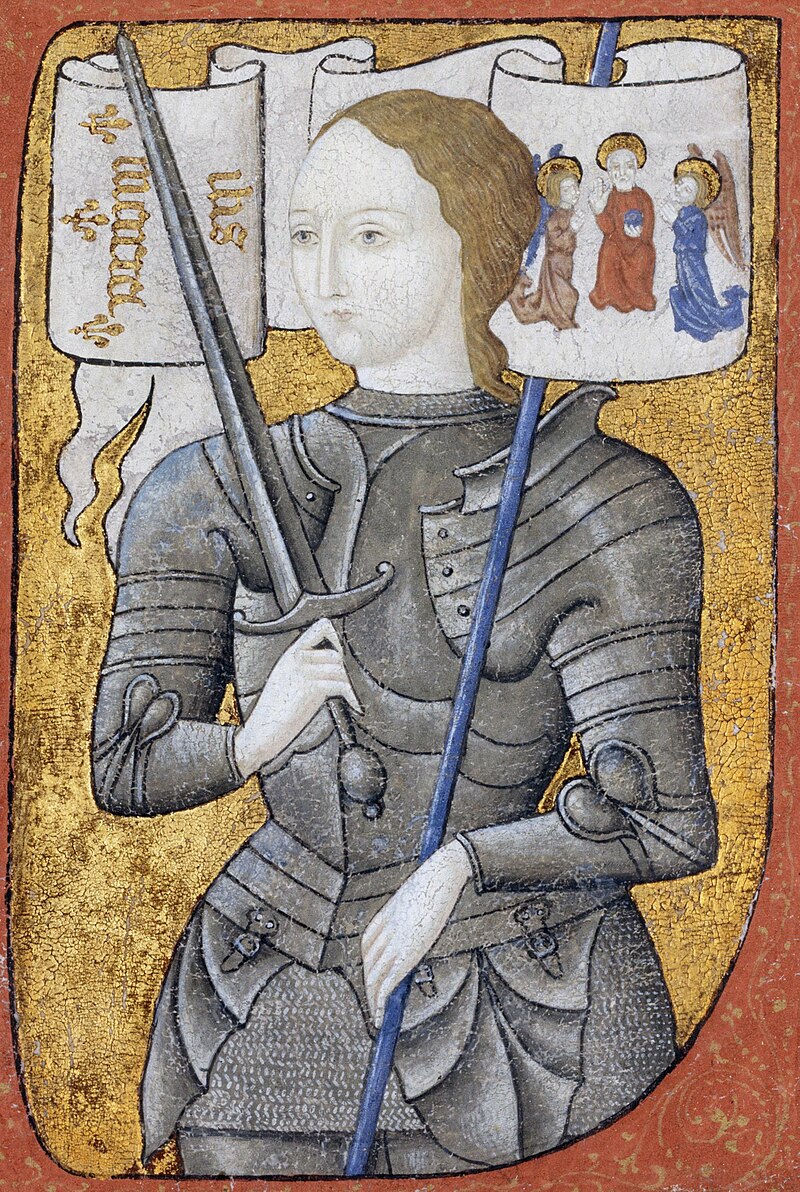
When Joan came to Chinon where the Dauphin was, the news that a prophet had appeared spread miraculously immediately over the whole of Europe. In a fortnight, she had convinced the Prince, and persuaded him to put her in command of the army to deliver Orleans. In eleven weeks she had achieved the whole plan: Orleans was delivered, the English army, under Talbot and Falstaff, was defeated at the battle of Patay; and the Dauphin was brought in triumph to Rheims and crowned. All this was done solely by the tremendous impetus of the Maid’s actions. Generals, Councillors, the Archbishop, the Dauphin himself, did all they possibly could to hinder; but they were swept onwards as though by an irresistible power. The Maid, leading her soldiers on horseback, went from town to town, wearing her armour and carrying her banner, painted with the words Jesus—Maria.
These eleven weeks are one of the most amazing moments of history. They really changed the face of Europe.
Betrayal, Capture and Trial
What happened after Rheims is nearly as astonishing as this triumph. Joan wanted immediately to conquer Paris, but the intrigues in the French camp became continually worse. The bridge over the Seine, which leads from St. Denis to the town, and which had been constructed on Joan’s orders, was removed by the Councillors of the King himself during the night, in order to prevent the carrying out of the plan. A section of the French Generals were in rebellion against Joan. So valuable time was lost. From this moment Joan was only a mascot in the army, and the Court wanted to get rid of her. These intrigues finally led to her imprisonment at Compiègne. When the French were returning to the fortifications after a sortie, the drawbridge was raised by the French and Joan and a small band of her followers were left outside and taken by the Burgundians.
Although there is some controversy on this point, a study of the whole circumstances makes it quite clear that the Court had lost all interest in the Maid and wanted to be rid of her. This is also shown by the fact that for months Joan remained a prisoner of my lord of Luxembourg who was quite ready to release her for a ransom; and even made the proposal to Charles. But nothing was done. And it was only after a considerable time that the English took the opportunity of bargaining with her captors for her. So she was handed over to the English and the trial in Rouen began.
I should like to emphasise that the French did not treat Joan any better than the English. The questions, for instance, that she had to answer before the Ecclesiastical Commission at Poitiers, which included the most famous theologians of France—before she was first acknowledged as a prophetess—are very similar to those she had to reply to at the trial. If one reads the account of this most searching examination at Poitiers, both physical and spiritual, and her answers, one feels there was very little difference between the French and the English inquisitors, and her naive reaction to both was the same.
Her Answers
She was asked: “Do you believe in God?”
“A good deal more than you do,” was the reply.
“In what language did the voices speak to you?”
“In a better language than yours.”
And further: “There is more in God’s Book than in all your books.” “God has a Book,” she added, “one which no cleric has ever read, however good or learned he may be.”
And at the trial: “Do you know if you are in the Grace of God?”
“If I am not in the Grace of God, may He put me there; if I am in the Grace of God, may He keep me there.”
Is this not a sublime answer given by the genius of humanity to the tortuous insinuations of theological subtlety? It makes very little difference to what nationality the theologians belong.
All the answers given by Joan, which are still preserved intact, if they were collected together and edited would form the substance of a new Christian revelation. I am sure I am not saying too much. John Lamond, author of a most remarkable book, Joan of Arc and England (Rider, 1927), says: “She was both Catholic and Protestant—one of the greatest of the Catholic Saints as is now fully acknowledged; and one of the most original of all the Protestants, seeing far more clearly into the essence of spiritual truth than modern Protestants will acknowledge.”
The Christianity which she professed is without doubt a direct continuation of something which lies at its very root—and has nothing to do with any particular denomination. She always insisted on the fact that the original revelation has not ceased and that she was the channel through which it could continue for the fulfilment of her mission.
The Shape of Modern Europe
Joan of Arc cannot really be claimed by any Church or any nation as their own. This especially applies to France and England. She made France—of this there is no doubt. She prophesied that seven years after her death, the English would have to leave France, and the main points of this prophecy were fulfilled as she had said: Paris was conquered, and in 1435 at the Congress of Arras, where nearly all the nations of Europe were represented, the change in public opinion became evident. France’s existence was definitely acknowledged. And twenty years later—when the same number of years as the length of her life had elapsed—France was what it is to-day. England, on the contrary, entered upon the worst period of its history: the Wars of the Roses began.
How can we picture this War of the Roses? It is the extermination of that nobility and knighthood which was really the aftermath of the old state when France and England were one.
In the Hundred Years War (1337–1437) between France and England, which came to an end through Joan of Arc, the English had the modern arms (gunpowder, etc.) while the French had the arms of the age of chivalry. The modern age really defeated the medieval. When the English had retired to their island, the medieval type of struggle continued in the Wars of the Roses (to put it bluntly) until the whole of the old knighthood, decadent as it had become, was finally extinguished. When it was over, modern England was born.
But this would never have been possible except through the entire withdrawal of the English from the continent; and this withdrawal was the result of the mission of Joan of Arc. Lamond1 says: “In the fifteenth century the Middle Ages were about to give place to our modern world, and their noblest representative is found in the person of Joan. No other figure stands out against the past at that period in such bright effulgence. After her advent France became a regenerated France, the land in which law and science and art had their appointed place. After her advent England became a new England, the England of Shakespeare and Milton, the England that was to rule the seas.”
Modern England is intimately connected with the foundation of modern experimental science, of political democratic liberty, and the modern world-economic Empire. But this England is bound to be a spectator of continental affairs and culture. For this purpose it must start from an isolated position—its own island. France, on the other hand, became the model of the modern state. Joan of Arc’s Dauphin—Charles VII—was the first King to have real absolute power, and centred this power in Paris. He was the first to introduce the standing army, with paid soldiers. That he did not gain his power by his own ability is clear; he never did anything at all, but all was done for him by the power which had inspired the Maid.
So both countries, England and France, were brought to their real mission for the modern age, by the deed of Joan of Arc. We have to distinguish between what is the real mission of a nation in respect of the whole of humanity, and what seems at any moment to arise as a nationalistic impulse. The two nations had to be separated. This could only happen, just at that moment, through the victory of France. This also shows that, with such a mission, the Maid had really to become a martyr of both nations.
But what of the whole of Europe? The real effect of the Treaty of Arras was that Burgundy, which had always been a buffer so to say between England and France, became a great independent state. It included Western France, Holland, Belgium and parts of the present Switzerland and Germany. All the wealth and culture of the Netherlands was included in Burgundy. It was the richest state in the world. Brabant was its capital.
Later, it was inherited by the Hapsburgs, so that at the threshold of the modern age it made the link between Austria and Spain; in short the Empire of Charles V of Germany became one “where the sun never sets,” as even America, discovered from Spain, was included in it.
So Burgundy became the nucleus of this vast Empire. But for this purpose it had to be withdrawn, at that particular moment, both from French and English influence. And this was accomplished by the Maid of Orleans.
Under the shadow of this Burgundian-Hapsburg Empire, there appeared what we can call the development of the German cultural life. The Reformation was nowhere so inward—as in its beginnings quite mystic—as in Germany. Meister Eckhart, Tauler, Silesius, Boehme, and even Luther himself, could never have found the right atmosphere for their development if the French or the English influence had become overpowering in Europe. The mission of the German nation was a mission of the inner life, and it had to work itself out in the struggle with this kind of imperial domination which left more possibilities open for individual variety of spiritual and religious life.
So the three great modern nations of Europe—France, England, and Germany, were separated through a kind of historical (and necessary) alchemy.
Her Gifts
But such world-historic processes cannot be carried out by the usual human capacities. And there is no doubt that the Maid of Orleans possessed capacities that were transcendent.
Lamond says: “The life of Joan of Arc cannot be understood, far less explained, apart from her gifts of clairvoyance and clairaudience… How idle for learned men to ignore such gifts!” And this ignoring is, I think, the main cause of the failure of so many of her biographers to do her justice. There is no shadow of doubt, for instance, as to the reality of her gift of prophecy. She announced that she would deliver Orleans; that in the course of the summer the King would be crowned at Rheims; she predicted her imprisonment, and many things that transpired at her trial; she foresaw the finding of her sword under the altar of St. Catherine of Fierbois; she won the confidence of the Dauphin in indicating that she knew the three secret requests of his prayer.
Of course all these things have nothing in them that is really super-normal. It is only our science which is not so far developed as to acknowledge occult phenomena as being a part of man’s normal nature! J. W. Dunne has proved lately in his Experiment with Time that everybody has prophetic dreams, but is too sleepy to recall them; and that they can even be developed by training. That would mean that we are not separated from knowledge of the future as we think we are, but only by our own inactivity.
The most remarkable thing about Joan of Arc was her extreme normality, both physical and mental. She was robust and healthy, full of endurance, possessed common sense to the utmost degree, had no sexual complexes, and was without fear. But she united all this normality with her so-called “abnormality.”
I think that the “superhuman” is a constituent part of the “human.” And to deny it, is to be “in-human.”
One thing she lacked entirely, and that was abstract intellectuality. And so she could be a channel—but a positive channel—for the flow of the spiritual forces which make history.
Born at the Turn of an Epoch
There is one other point—the date of her birth. She was born on January 6th, 1412. I think that an unprejudiced study of history leads to the recognition of cultural epochs of about 2,000 years. They coincide with the passage of the vernal point of the Sun from one sign of the Zodiac to the next. Our modern culture-epoch began in the fifteenth century. All modern science and discovery dates from then.
Now the most striking fact is that the birth of the Maid coincides almost exactly with the entrance of the Sun into the constellation of Pisces (1415)—the exact point of the commencement of a new culture.
If we bring together all that we have said about the map of Europe, it explains why the instrument who had to bring this about had to be born just at this cosmic moment.
The day of her birth is given by Percival of Boulainvilliers as January 6th. His document is one of the most genuine of all her contemporaries’. Some have some doubt of it, because he describes how the whole of Nature in that district—having collected his information from the villagers—responded to the moment of her birth: how the cocks, “as heralds of this happy news, crowed in a way that had never been heard before, beating their bodies with their wings; continuing for two hours to prophesy this new event.”
January 6th is known as the “day of the three Kings” or Epiphany, and brings to an end the thirteen “Holy Nights” after Christmas. This period has always been spoken of in ancient tradition as the great period of initiation; and it was pointed out that during these days and nights even the Earth was in a quite different condition from that of any other time. This is supported by innumerable legends, sagas, folklore, etc. In Swedish folklore, the wonderful poem of Olaf Asteson is a very striking example of an initiation through Nature.
In the case of Joan of Arc we find an immense number of records of her childhood, all of them connected with a Nature suffused with an atmosphere of fairy-tale, and mythology. Near her village was the “hoary wood” (Bois Chenu) from which the so-called “Prophecies of Merlin” had said that the Virgin whose mission was the liberation of France, would come. This was a subject ardently discussed by the peasants at the time of Joan’s birth—was she the Virgin who would liberate France?
A complete study of all these records would show that there is an intimate connection between the birthplace of Joan and Celtic Nature-lore. But all that is “pagan” in it, is transformed into an esoteric Christianity. This has been first fully explained by Rudolf Steiner.
The birth on January 6th would indicate that what had once been a kind of Nature-initiation lasting during the thirteen nights, was experienced by the Maid in her last pre-natal days, and was transformed into her extraordinary natural gifts of clairvoyance, which then began to manifest themselves suddenly when she was twelve years old.
I have seen the horoscope of the day of the birth of the Maid, and it would be possible to demonstrate how the horoscope of this particular day entirely fits in with the horoscope of the changing cultural epoch.2 In fact from this coincidence, the birthday can be said to be the actual beginning of the new age.
The Christian Sybil of the Modern Age
It is a remarkable fact that the appreciation of Joan of Arc has had to meet with so many crises in the course of time. Shakespeare gives a very grotesque picture of her in his Henry VI; Voltaire jeers at her in La Pucelle; … Schiller was the first to vindicate her again, and his play had the greatest influence not only in Germany but in the whole world. But in our own time it seems that with Anatole France and Bernard Shaw the pendulum has swung back again. Both these are so far removed from any real understanding of Joan of Arc for two reasons. One is, that they don’t believe (both in different ways of unbelief) in the reality of the spiritual background of her life. And the other is, that they do not see the historical background of the changing epoch.
Joan of Arc is the Christian Sybil of the modern age. What she listened to with her heart and carried out with her dauntless courage, shaped the destinies of the European nations.
- John Lamond, Joan of Arc and England (Rider, 1927).
- “A book which I most heartily recommend, which includes most valuable material about Joan of Arc as the inaugurator of the new epoch along the line mentioned above, is Jeanne d’Arc, by Ludovicus Mirandolle (Dutch), Amsterdam, 1931.” — E.K.
- [Ed.] Section headings are editorial additions for the web edition; the original text runs continuously. Obvious scanning errors in the source PDF have been silently corrected; the author’s wording is otherwise unchanged.