

Sir Christopher Wren (1632–1723): An Inductive Biography

Sir Christopher Wren (1632–1723)
An Inductive Biography
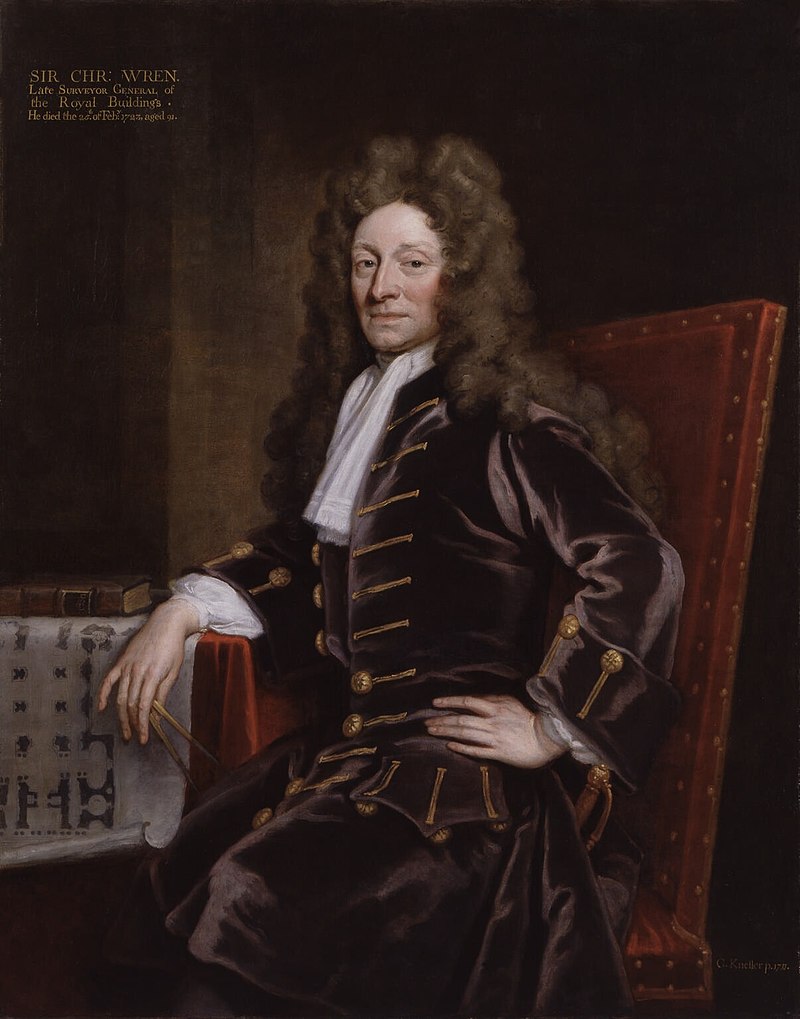
This article is one of six ‘Inductive Biographies’ which Eugen Kolisko wrote in 1938–39 for The Modern Mystic, immediately after his essay series on reincarnation. An ordinary biography moves forwards, from childhood to the individual’s contribution; Kolisko reads a life inductively — beginning with that contribution and asking what individuality, and what destiny, it reveals. Read this way, a biography makes a karmic perspective visible: a life shows itself as a task carried into the world. His contribution is London itself — the Royal Society and the rebuilt city — and Kolisko traces both back to the quiet master builder whose only monument is the instruction: look around you.
The Architect of More than St Paul’s
Sir Christopher Wren is known in general as the architect of St. Paul’s Cathedral in London. Few people know that he was really the architect of all modern London. It is even less known that he was the inspirer of the foundation of the Royal Society and, with that, of modern sciences. And practically no one knows that the inauguration of Freemasonry in England was mainly due to his influence. He was born on October 20th, 1632; his family was Royalist ; an ancestor, Geoffrey Wren, was Chaplain and Privy Councillor to Henry VII and Henry VIII. The uncle of Christopher, Matthew Wren, was Chaplain to Charles I, Dean of Windsor, and Bishop of Ely. He became famous for his loyalty to the King and was imprisoned by Cromwell for eighteen years in the Tower. The father of Christopher succeeded his brother in the Deanery of Windsor and the Registrarship of the Order of the Garter. He was also one of the original members of the Royal Society. The whole family, (called “ Wren’s Nest,”) was involved deeply in all the struggles of the time.
Christopher did not make the Church his profession, but from the very first was an “infant prodigy“ in science.
On account of delicate health he was educated to begin with at home. When he was only nine years old he wrote a most learned Latin letter (which has been preserved) to his father; at thirteen, he made his father a present of an instrument which he had invented himself and which he called “Panorganum Astronomicum.” Its purpose seems to have been to track the path of the heavenly bodies and show their effect on the recurring seasons of the year. An essay, on the Origin of the Rivers, was also dedicated to his father, at the same time.
In the same year (1645) he went to Westminster School. In 1646—at fourteen—he was admitted as a gentleman commoner to Wadham College, Oxford. In November, 1653 he was elected Fellow of All Souls’ College and proceeded to the degree of Master of Arts. Already in 1657 he obtained the Chair of Astronomy at Gresham College, London—he was then twenty-four—and in 1660 he was appointed Savilian Professor at Oxford.
The Philosophic Club and the Royal Society
How can one account for this extraordinary career? It is in close connection with the history and early days of the Royal Society. As early as 1645, during the most stormy days of the Revolution, a little band of philosophers and scientists was meeting for discussions in Gresham College. A branch of this group was in Oxford at Wadham College, and called itself the ” Philosophic Club.” In their meetings all inventions and scientific experiments of the time were discussed. We find in this group such names as Dr. Glisson, the famous anatomist, Wallis, the mathematician, Dr. Jonathan Goddard, Professor of Medicine and Chemistry and first English constructor of the telescope; Dr. Wilkins, who had married one of Cromwell’s daughters, and most distinguished through his physical experiments; the famous Robert Boyle was also one of the original members: and often the meetings took place in his apartments. Later, John Evelyn (the historiograph of London), Ashmole, the Rosicrucian, Sir Charles Scarborough, the translator of Euclid and collaborator with Harvey; Robert Hooke, the discoverer of the cell, joined these meetings.
The boy Christopher was introduced there by his father, Dean Wren, who was also a member.
We can hardly imagine the intensity of this new world of learning, in which all these scientists and philosophers met and worked freely together without being separated in any way by the barriers since erected by modern specialism. At this time it was still possible for the same person to be both an anatomist and a mathematician: and every discovery or invention was hailed with enthusiasm as yet one more gift for the whole of humanity.
Among all these, the most astonishing phenomenon was Christopher Wren himself. He had a quite wonderful gift of invention. The Rev. William Oughtred, a famous mathematician and also one of the original group, describes him as “an ingenious youth, who although not sixteen years of age, has enlarged the sciences of astronomy, geometrics, statics and mechanics.” Evelyn calls him “that rare and early prodigy of universal science.” Robert Hooke, in his preface to the book Micrographia, says: ” the hazard of coming after Dr. Wren did affright me, for of him I must affirm that since the time of Archimedes there scarce ever met in one man, in so great a perfection, such a mechanical hand and so philosophical a mind.”
Newton speaks of Wren, Wallis, and Huygens as “the three princes” among geometers and gives to Wren the credit of having been the first to communicate to the Royal. Society the laws concerning the impacts and reactions of two bodies in collision.
The Universal Inventor
In Parentalia, an account of Wren’s life and works compiled by his son, and published in 1750 by his grandson, there are long lists of his inventions, which he presented to “that ingenious company of experimental philosophers.” Among them (to mention only a few) were: an automatic weather-clock; an artificial eye: the “diplographic instrument“ for writing with two pens at once; several new ways of graving and etching; new ways of sailing and submarine navigation, etc. He was the first to inject liquids into the blood of animals, and is therefore the discoverer of blood-transfusion and injection. He was the first to use the microscope for examining the structure of insects, and tissues generally. Robert Hooke, the author of Micrographia, says quite openly in his Preface that all the technique and art of microscopical drawing and general ideas had been invented by Wren, and he was only publishing them.
Wren was the perfecter of the barometer, invented originally by Torricelli, and was the first to give a real explanation of the changes in the barometer as due to the density of the atmosphere. In astronomy Wren’s dissertation on Saturn and its phases, was considered to be epoch-making. He discovered a method for calculating sun-eclipses ; and constructed, by order of the King, the first lunar globe. His inauguratory address on taking the Chair of Astronomy at Gresham College has come down to us (in Latin and English) and is one of the most remarkable documents of modern science. There he gives a most living description of the influence of the planets and the stars in the human organism ; how celestial influences are working upon blood, brain, and other organs ; also on the weather, animals, plants, and diseases etc. He gives also description of how all the various planets are contributing their special qualities to the city of London. This both serious and humorous description we heartily recommend to our readers to-day!
It is clear that Wren unites an ancient wisdom with a modern science. He says “that there is a true astrology to be found by the enquiring philosopher which would be of admirable use to physic, though the astrology vulgarly received cannot but be thought to be extremely unreasonable and ridiculous.” I think that our modern science to-day is only just beginning to realise what was entirely forgotten under Wren’s successors, namely the influence of the stars on terrestrial substances.
Wren was connected with the Royal Society from its birth— when he was a boy—until his death. He was present at every meeting. He was made its President. The part that he played in connection with all its transactions, has remained a wonder which is recognised by all its historians.
In the Bicentenary Memorial Volume to Wren (Hodder & Stoughton, 1923), contributed to by a long list of eminent men, there is an account by A. R. Hinks (Gresham Lecturer in Astronomy) which gives a survey of his astronomical and scientific work, from which it becomes evident that nearly all the inventions and discoveries of this group were due to Wren—“Wren’s work is hidden away in other people’s books, partly because he was so little inclined to publish himself.” …” Wren was reputed the Archimedes of his age, was in the habit of throwing off suggestions on all kinds of scientific matters, is credited with the first idea of many instruments that were afterwards brought into use by others.” … For instance, Hinks gives plain evidence that Wren was not only the architect of Greenwich Observatory but really gave the plans for all the instruments, invented the new lenses, and in short, was really the inaugurator of the whole institution.
But the same applies to many other things. In short, there is any amount of evidence which shows that Wren’s influence and achievements were behind everything; he was the inspiring genius of the Royal Society. Oldenburg, the Secretary of the Society, and one of the first of its collaborators, was later convicted of having the dubious habit of giving away great numbers of the discoveries of various members to scientists on the continent, which were later all made known under other names. This also helped to bring it about that the Royal Society can really be held to be responsible for the sudden dissemination of all the fundamental discoveries of modern science over the world. And we must always remember that behind all, stands the “great unknown“ influences of the Master, Christopher Wren.
A Christian Occultist
That Wren was not merely a “scientific“ astronomer, can be shown by a passage in his (above-mentioned) Gresham address which is as follows: “Some, it may be, will knit the brow it I should say that even Holy Scripture itself sometimes requires an astronomical interpreter.”
He makes a most occult observation in asking, how, without the aid of astronomy, the theologian can explain the problem how our Saviour, who was buried on Friday night and rose again before daybreak on Sunday, “could be said to have been three days and three nights in the sepulchre, when His stay there was but one full day and two nights?“ “The world,” he says, “has hitherto shifted off this difficulty with a synecdoche, by taking in parts of Friday and parts of Sunday. But yet there wanted a third night.” He gives the following solution, which shows him to be a Christian occultist, well aware that Christ has something to do with the whole earth.
He says: “While there was made by the motion of the Sun, a day and two nights in the hemisphere of Judea, at the same time in the opposite hemisphere, was made a night and two days: join these together, you have three days and three nights ; for Christ suffered not for Judea alone but for the whole world; and in respect of all the inhabitants of the earth, conjunctim. He rested three days and three nights, though, in respect of Judea, or any particular horizon, but one day and two nights.”
The Turn to Architecture
This, so far, is a picture of Wren the universal prodigy of modern science. But have we not always thought of him as an architect? Here we come to the greatest wonder of all. It is admitted by all his biographers that he had had no practical training in architecture whatever.
Immediately after the Restoration (1661), when he was known as the great Professor of Astronomy at Oxford, he was first appointed assistant and later Deputy (1666) to the Surveyor General of His Majesty’s Works, when he also became Principal Architect for the rebuilding of the City of London. This was just a few months before the Great Fire of September. In 1669 he was appointed Surveyor.
The year before, 1665, Wren was thirty-three years old; and he left England, for the first and only time, and went to Paris, where there was a “general congress of the most celebrated masters in every profession,” inspired by Cardinal Mazarin.
“I have,” says Wren in the fatuous letter describing his Paris visit, “busied myself in surveying the most esteemed Fabricks of Paris and the Country round; the Louvre for a while was my daily object, where no less than a thousand hands are constantly employed on the Works; some in laying mighty Foundations, some in raising the Stories, Columns, Entablements, etc. with vast Stones, by great and useful Engines; others in carving, inlaying of Marbles, Plastering, Painting, Gilding etc., which altogether make a school of Architecture the best probably this Day in Europe.”
He then describes how he was studying the architecture of Paris and all its surroundings—in fact of nearly all France, and says, after enumerating them: “ all which—and I might add many others—I have surveyed and that I might not lose the Impressions of them, I shall bring you almost all France in Paper, which I found by some or other designed to my Hand, in which I have spent both Labour and some Money.”
Then he meets Bernini the famous Italian architect who had just finished the Colonnades and St. Peter’s in Rome. Wren proceeds: “ Bernini’s Design of the Louvre I would have given my skin for, but the old reserved Italian gave me but a few Minutes View. … I had only Time to copy it in my Fancy and Memory.” … “I hope I shall give you a very good Account of all the best Artists in France. My business is to pry into all Trades and Arts. I put myself into all Shapes to humour them; ‘tis a Comedy to me, and tho’ sometimes expenceful, I am loth to leave it.” …
This visit to Paris represents the turning point of Wren’s career. He went there as an astronomer, and he returned as an architect. What he obtained in Paris was really a whole picture of Italian Art focussed in Paris at this significant moment. St. Peter’s had been completed—in 120 years, by twenty successive architects, among them, Bramante, Michael Angelo, and Bernini. The meeting of Bernini and Wren is the symbol of the transference of St. Peter’s—the final achievement of the Italian Renaissance—to England, in St. Paul’s Cathedral, but through the medium of France.
This short visit prepared Wren for his new task, for which he had had no previous instruction. But now he had to find an opportunity for its application.
The Great Fire and the Plan for London
Here destiny steps in. The Great Fire destroyed the old London, with its fifty Churches, its Cathedral, and all its monuments. It is interesting that Wren was already, in appointment, architect, and Surveyor General, for the rebuilding of London, when the fire broke out. The Royal Society, too, had just been definitely founded, and Wren was studying the events of the Great Plague and its combatting. Some days only after the fire he produced an already elaborated plan for the rebuilding of the whole City. This plan is also one of the miracles of Wren’s genius.
S. D. Adshead (Professor of Town Planning, University of London) says in his contribution to the memorial volume (as above) that the plan was not merely architectural but also hygienic and artistic, with provision for every detail necessary for the life of a community. If it had been carried out completely, there would I am sure have been no traffic problem in London to-day.
St. Paul’s was intended to be in the centre of a great square, and all the churches and other buildings he constructed later were indicated in the plan. Although it was not carried out according to the original idea, it becomes evident—if one looks down from the top of St. Paul’s—that modern London, with the fifty-three churches built by Wren, the twelve Halls, the Monument, Greenwich, etc., etc., is practically the realisation of this ideal scheme—the churches appearing like landmarks in the later chaos of modern London.
This plan has really fallen from the heavens! And the same applies to St. Paul’s Cathedral. His “favourite“ design shows what he really had in mind, which could not be carried out owing to disagreements with unavoidable commissions and committees. But the main structure and especially of the dome, is like a realisation of modern mathematical genius.
Wren did everything. Designs, details, from first to last were all carried out under Wren’s supervision. There is no other instance anywhere in the whole world, where such a great building has been entirely constructed, planned, and carried out by one man.
Wren held his post as Surveyor from 1666 till 1718—fifty-two years. No building in London, and no important building anywhere in England, was put up without his direct or indirect participation. Since the Great Fire, his whole biography was little else than a catalogue of his buildings. The greatest of scientists transformed himself into the greatest of architects. But the same modesty prevails throughout. The buildings are there, but there is no record of the builder. Even to-day there exists no statue of Wren. The only memorial is an inscription on his tomb in the crypt of St. Paul’s: Si monumentum requiris circumspice. “If you want a monument, look around you.”
What then is this “monument”? Where must one “look around?” From the summit of St. Paul’s. The monument is London itself.
Science Become Art
It is by no means mere chance that London—the practical centre of modern civilisation—is built from a plan made by the occult founder of modern science.
In the first part of his life Wren inaugurated the Royal Society founded on Bacon’s principle of experiment, and through it, modern science. In the second part, he built the City. His Science became Art. London is the result.
Both are, in themselves, riddles. But one throws light on the other.
Where lies the occult root of this Union of Science and Art, represented in a single human life?
Wren and the Birth of Freemasonry
This brings us to the third element in Christopher Wren’s life. It is his intimate connection with the birth of Freemasonry in this country.
Wren was twice elected to the honourable and distinguished office of Grand Master of the Ancient Order of Free and Accepted Masons ; and continued to preside over the fraternity till the death of King William.
In 1666 (the year of the Fire) Wren was nominated Deputy Grand Master. I quote here from the most valuable work of James Elmes, Sir Christopher Wren and his Times (London, Chapman & Hall, 1852): “he distinguished himself above all his predecessors in legislating for the body at large, and in promoting the interests of the lodges under his immediate care. He was Master of the St. Paul’s Lodge, which, during the building of the Cathedral, assembled at the Goose and Gridiron in St. Paul’s Churchyard, and is now the Lodge of Antiquity, acting by immemorial prescription, and regularly presided at its meetings for upwards of 18 years.”
The three mahogany candlesticks, also the trowel and mallet which Wren used in laying the first stone of St. Paul’s on June 21st, 1675, are still preserved in that lodge. In 1710, when the Cathedral was about to be finished, it is described that the final stone was laid in the ball above the dome, and that this was done with masonic ceremonial by Wren’s son, and with his assistance.
The St. Paul’s Lodge is one of the four lodges which, under the name of Lodges of Antiquity were incorporated in the Grand Lodge in 1717 when the public inauguration of Freemasonry took place. It was characteristic of all Wren’s activities that he was not always obviously connected with them. In the case of the Royal Society his influence is felt through the work of Hooke and others, and in the case of the rebuilding of London much more was accomplished by him than is accredited to him. The same applies to his masonic activities. We find him as Master of the St. Paul’s Lodge which actually worked within the precincts of the Cathedral, whilst later, as we have seen, he became Grand Master of the Ancient Order of Free and Accepted Masons. By the accepted argument of analogy we conclude that he played the same part in all his Activities and that his close masonic Brothers were to be found among both the scientists and architects who furthered his schemes with the Royal Society and with the rebuilding of London. It is clear that the “outside“ masons, i.e. the actual labourers engaged in the rebuilding of the Cathedra] were at the same time the “guild“ masons belonging to the old masonic tradition, embodying a certain physical and objective reality. But the personnel of the Philosophic Club and the Royal Society had a mission of a parallel but essentially spiritual nature. These two processes were united in one man— Wren, who was first the greatest scientist and then the greatest architect of his time. I suggest that 1717 marked not the beginning, but the end of Freemasonry as a purely spiritual force.
Is it not significant that the retirement of Wren in 1718 after fifty-two years of office almost coincided with the adoption of a system of rituals in 1717? Wren is intimately connected with the living processes of the unity of the arts and sciences of which he, in his own person, was the embodiment. He was the master spirit of his age which affords the key to his three-fold operations. The infant prodigy developed into the man of genius who, conscious of the spiritual forces working within him, performed the labours of a daemon.
We now more fully appreciate the judgment of Isaac Barrow of Gresham College who declared: prodigium olim pueri, nunc miraculum viri, imo daemonium hominis!
- [Ed.] Section headings are editorial additions for the web edition; the original text runs continuously. Obvious scanning errors in the source have been silently corrected, including two dates the old typesetting had made impossible (Fellow of All Souls 1653, the Gresham chair 1657); the author’s wording is otherwise unchanged.