

Sir Thomas More (1478–1535): An Inductive Biography

Sir Thomas More (1478–1535)
An Inductive Biography
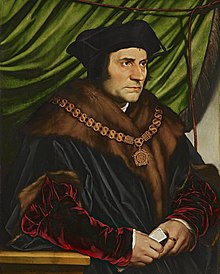
This article is one of six ‘Inductive Biographies’ which Eugen Kolisko wrote in 1938–39 for The Modern Mystic, immediately after his essay series on reincarnation. An ordinary biography moves forwards, from childhood to the individual’s contribution; Kolisko reads a life inductively — beginning with that contribution and asking what individuality, and what destiny, it reveals. Read this way, a biography makes a karmic perspective visible: a life shows itself as a task carried into the world. His contribution is Utopia — a book Kolisko reads as a seed of modern social thought — and he traces it back through the striking parallels that bind More’s destiny to Thomas Becket’s, four centuries apart.
Two Thomases, Two Henrys
This article is written especially to show the remarkable coincidences between the lives of Thomas a Becket and Sir Thomas More; also between both the King Henrys— Henry II and Henry VIII.
As I have previously written articles for the Modern Mystic on the subject of Reincarnation, I feel it should be pointed out that it is not my intention here to suggest that any conclusion should necessarily be drawn with regard to reincarnation in connection with these four lives. Rather, I would emphasise how, in these two periods, “history repeats itself” in a most remarkable manner, and that the beginning of the modern age is intimately connected with the events described here.
The best way to compare the lives of the two Thomases would be to set out the principal events in tabular form. But before doing this we can briefly summarise the already well-known life of Sir Thomas More.
The Making of Thomas More
He was born on Friday, February 7th, 1477, between two and three o’clock in the morning, in Milk Street, Cheapside, London. He went to school at St. Antony’s, Threadneedle Street, under the tutorship of Nicholas Holt. When he was thirteen he entered the household of John Morton, Archbishop of Canterbury and Lord Chancellor to Henry VII. This household is described by Dr. W. A. Reed as “a school of renaissance culture and homely blunt wit,” and he has traced to it the beginning of a movement towards a freer kind of imaginative drama.
The Archbishop was very fond of Thomas More, and said of him: “This child here waiting at the table, whosoever shall live to see it, shall prove a marvellous man.” Thomas was gifted with a dramatic sense, and often took part in the plays which were performed there. He developed too his talent for poetry and his remarkable gift for oratory for which he later became famous. The Archbishop (probably in 1492) sent him to Oxford where he entered Canterbury College.
His father intended him for the Bar, but Thomas was enthusiastic for classical learning. Greek, only recently “rediscovered“ in England, attracted him, and through his enthusiasm, the movement for the “ New Learning “ was established with the help of his fellow-students and friends—John Colet and William Latimer. He was however obliged to follow his father’s wishes, and in 1494, he began his legal training at Lincoln’s Inn and was very soon famous for his great ability and learning. In 1499 there took place the great meeting between Thomas More and Erasmus of Rotterdam, the “prince” of the Humanists. Colet was their mutual friend, and had already prepared Erasmus for meeting young More whom he described as “England’s one genius.” Erasmus, at a reception, while having a brilliant discussion with a young unknown opponent whose wit and readiness much impressed him, exclaimed suddenly: “You are no one, if not More!“ And More instantly retorted: “And you are Erasmus—or the Devil!“ From that hour, they were inseparable friends. Erasmus stayed many times in More’s house, and wrote there his famous In Praise of Folly (Encomium Moria)
They really wrote it together, and More made jests about the coincidence of his own name Morus, being derived from the Greek Moria, folly,—he himself being, so to say, the “fool.”/
During this visit of Erasmus they both went to see the boy Prince, later Henry VIII—then nine years old—and More presented the Prince with a poem. Erasmus was annoyed at this, as he had not been warned to be prepared to do likewise.
The years from 1499 till 1503, were the critical years of More’s life. He became suddenly inclined to asceticism—vigils, fasts, prayers and meditations filled many hours. He often scourged himself, and from this time on he wore “a sharp shirt of hair next his skin.” He even wanted to become a Franciscan friar, and practised the spiritual exercises of the Carthusians. But in 1504, he suddenly changed his mind—he “decided that he could be a good husband, while he feared to become a bad priest.”/ At once he began to woo his future wife, Elizabeth Colt; and after her death in 1511, re-married in a few months, his second wife being Mrs. Alice Middleton, a widow.
More’s “Household“ is famous. Surely, he was the most perfect paterfamilias that ever existed on earth!—we need say no more about this remarkable centre of learning and hospitality—as anyone can read it for themselves in Roper’s (his son-in-law’s) book The Mirror of Vertue in Worldly Greatness. Three daughters and three sons-in-laws—his “boys“ as he called them and ill of them brilliant—formed the first nucleus (dare we say it?) of co-education! And it was a dazzling success. Holbein has immortalised this household—even to the family pets. He was a frequent visitor to this centre of the New Learning.
In the Service of Henry VIII
In 1509 Henry VIII ascended the throne. More had known him since his childhood. For those who to-day have the traditional knowledge of the “private life“ of Henry VIII, it will come as something of a surprise to learn that in his youth—with his great intelligence, his strength, his courage, and his wit, Ms generous impulses, and his amazing talents—he aroused an enthusiasm among people who saw in him the dawn of a new age. A Venetian ambassador (and is this not even more surprising?) reports: “his face is angelic and his person of singular beauty“ …”his face is so very beautiful that it could become a pretty woman“! This was of course no pleasantry, but the absolute truth. Henry’s great versatile gifts caused him to declare that “life without men of letters would be merely useless existence.”
With Henry’s accession began the political career of Thomas More. He became the ambassador for all the secret commissions of the King. He was constantly at court, and was the confidant of both the King and his Queen Catherine of Aragon (widow of the King’s brother Prince Arthur) whom he had married in 1509 by special dispensation of the Pope. Roper relates:
“The King used upon Holy Days, when he had done his own devotions, to send for him (More) into his traverse, and there sometimes in matters of astronomy, geometry, divinity, and other such faculties, and sometimes of his worldly affairs, to sit and confer with him. And other whiles would he in the night have him up into his leads (on the roof) there to consider with him the diversities, courses, motions, and other operations of the star.-and planets.”
When Henry produced his book against Luther in 1521, he was considerably helped by Thomas More; it was this book which gained for Henry the title of Fidei defensor. And when Luther replied, in his boorish way calling the King the “royal sow of England“—“die Königliche Sau von Engelland “—More had to make a rejoinder under a. pseudonym “William Ross,” since the King’s position forbade him to reply himself. Thirteen years later, during his trial, More was accused of having “provoked“ the King “by subtle sleights“ to write his book against Luther.
Utopia
In 1515 More was sent upon a diplomatic mission to Flanders, and there, during his stay at Bruges, he wrote the work that has made his name famous, the Utopia—an occult inspiration of the greatest importance. No one to-day understands it. It is, I think, an imaginatively inspired picture of an ideal state that had been an actual reality in Atlantis. Plato’s Republic is of course the same. Neither of them point to the future, but really to the past. Utopia means “not anywhere.” The character Raphael Hythlodaye, is described as a man who journeyed with Amerigo Vespucci; he “met“ Thomas More in Antwerp and told him that he had found an island in the ocean where at! these things existed; but Raphael is not an actual living person; he is More’s “inspirer“ who appeared to him and gave him the whole material. Utopia was, for More, what the Praise of Folly had been for Erasmus; it caused him to be acknowledged as the unrivalled genius of English letters.
Utopia was written in Latin. But his other writings are in English, and contributed enormously—together with his letters and speeches—to the real establishment of English literary language.
More’s political career reached its zenith when, in 1529, he was created Lord Chancellor and Keeper of the Privy Seal, after Cardinal Wolsey’s downfall.
The Tragedy Approaches
But already the tragedy of his life was approaching. It springs only from the fact that King Henry VIII took the fatal— but world-historic—step of seeking to divorce Catherine of Aragon. As this divorce could not be granted by the Pope, Hanry took matters into his own hands. As he wanted to marry Anne Boleyn, and divorce Catherine, he made himself Head of the Church, and intituled the Oath of Supremacy. To take this oath was for More, an impossibility. So he resigned his Chancellorship in 1332. He told Henry quite frankly that he did not agree with his actions, but that he would keep silence with regard to his opinions. He insisted on his freedom of conscience, and “claimed that the Statute could not condemn him for such silence, for neither it, nor any laws in the world, could punish a man except for deeds or words—not, surely, for keeping silent.”/ “He had never denied,” he said, “the King’s supremacy, though he refused to take the oath to support it.” From 1334 to 1333 he was confined to the Tower, and in his ultimate trial was condemned to be hanged, drawn, and quartered—a sentence which was later commuted by Henry into beheading.
More’s letters written in the Tower to his daughter Margaret, are priceless expressions of spiritual courage and equanimity. Roper gives an interesting detail of his last hours : “The day before he suffered he sent his shirt of hair, not willing to have it seen, to my wife, his dearly beloved daughter, with a letter written with a coal, plainly expressing the fervent desire he had to suffer on the morrow.”
About his death, More says in his last letter:
“… I would be sorry if it should be any longer than to-morrow. For it is Saint Thomas’ even,/ and the octave of Saint Peter ; and therefore to-morrow long I to go to God ; it were a day very meet and convenient for me.”
His last words on the scaffold, spoken to the people, were : “I call you to witness, brothers, that I die in and for the faith of the Catholic Church ; the King’s loyal servant, but God’s first.”
His death roused the whole Christian world. The Emperor Charles V, said to the English ambassador, when he heard the news: “had we been the master of such a servant, of whose doings ourselves have had these many years no small experience, we would rather have lost the best city of our dominions, than have lost such a worthy councillor.”
This was the reaction everywhere. The Church declared him a martyr. He was beatified in 1888, and made a Saint, recently, in 1933. Now let us compare this life of Thomas More, Chancellor to Henry VIII, with that of Thomas Becket, Chancellor to Henry II.
The Parallel Reigns
It has occurred to many historians that there is a very unusual parallelism between the reigns of Henry II and Henry VIII. Those reigns represent the two incisive stages in the ascent of supremacy of temporal power over spiritual power—quite concretely—in the persons of Henry II and Henry VIII.
In Henry II’s time the struggle arose over the question of investiture—that is, in whose hands the power of investiture should rest. As in a nucleus, the whole question is set forth in the famous state documents the “Constitutions of Clarendon,” drawn up in 1164. Mrs. J. R. Green (Henry II, 1926, Macmillan) characterises their general trend in the following way:
“They boldly attacked the whole of the pretensions of the Church; they threatened to rob it of a mass of financial business, to wrest from its control an enormous amount of property, to deprive it of jurisdiction in the great majority of criminal suits, to limit its power of irresponsible government, and to prevent its absorption into the vast organisation of the Church of Western Christendom. They defined the relations of the English Church to the Sec of Rome. They established its position as a national Church, and declared that its clergy should be brought under the rule of national law.”
Sidney Dark, in his St. Thomas of Canterbury (Macmillan, 1927) says:
“The fourth clause, forbidding Church dignitaries to leave the country without the consent of the King, was another serious blow at the liberty of the Church, intended of course, to prevent consultations with the Pope, and designed to make the Church in England a semi-independent insular institution, powerless to resist an autocratic King—Henry II intended what Henry I/III achieved.” (My italics.)
We can also quote from Campbell’s The Lives of the Lord Chancellors and Keepers of the Great Seal of England (2 vols):
“We Protestants must approve of the whole of them (the Constitutions) for they in a great measure anticipate the measures which were taken when the yoke of Rome was thrown off at the Reformation… .” (Of course a reference to Henry VIII.) Also, Campbell is anxious to point out that the Constitutions really amounted to this: “All appeals should be carried from the Private (Becket) to the King.” And he adds: ”Henry (II) would have been himself Head of the Church.” And: “No one ventured to oppose the King’s will except Becket.”
If we could imagine a Henry II transplanted from the medieval age into the Renaissance—(which was the age of tyranny and struggle for individual freedom)—and thus set free from every puerile fear of papal interdicts, loss of the Grace of God, and all the other shadow inhibitions of the Middle Ages— then we should find a man with precisely the mentality and recklessness of Henry VIII.
On the other hand the cultural atmosphere of Bernard of Clairvaux and all his pupils, including John of Salisbury, friend of Becket, and the “flower of English learning,” with their world-wide Christian-Platonic international aims, seems like a medieval stage of the same thing that appears in the Renaissance as the Humanism of people like Erasmus, More, Colet, Pico della Mirandola and others. The one brings the original Latin, and the other the original Creek and Hebrew texts, and with the latter comes the longing for a refined and intellectual revival of art, letters, and science. But then we are already on the threshold of our modern science.
The real representative of this stream in England is without doubt Sir Thomas More. In his Utopia he blends together the vision of the past with the picture of the modern ideal of social progress and human welfare.
It is most remarkable what a suggestive power this word “Utopia” has achieved! One cannot escape from it in presenting any form of the idea). And still more remarkable is the fact that the foundation of More’s Utopia an economic one. The tragedy is that his vision of the past is a misfit it carried into the future, and even cannot suffice to solve the problems of the present. On the one hand, More was far ahead of his tunes, but in all his other writings, centred around the facts of the Reformation, he is ”rooted” in his own age. His psychology is a double one. Although, from the point of view of the Papacy, his Utopia was a contradiction, and he might even have been punished for it if it had not been an “ideal and fictional“ state, vet he was made a Saint, because he could not deny the supremacy of the Pope nor the institution of the Church as a spiritual power.
The Two Oaths
Looking more at the details, one is struck by the fact that the whole relationship between More and Henry VIII and the taking of the Oath of Supremacy, has a most striking resemblance to the situation between Becket and Henry II. Everything turns upon these Oaths of Supremacy. Moreover, both Becket and More foresaw the inevitable doom that awaits them.
The two formulae and all the discussions are almost identical. Becket always insisted on making the reservation: “saving the honour of my God,” —meaning saving the honour of his conscience. This reservation always aroused the furious passion of the King. The two were face to face in the struggle. In the case of More in his trial for refusing to take the oath, either with or without “reservation,” he insists not upon freedom of speech! but upon the freedom of silence. For this, he was accused of malice. One could wish that an impartial historian would gather together every detail from these two historical moments! It is surely a great enigma—that the same problems, the same names, the same relationships, the same vital struggle—should occur twice over in the history of the same realm.
The Trial of the Dead Becket
The extraordinary climax to the whole thing (which was really the reason that I was drawn to examine all these events) lies in events which happened three years after the execution of Sir Thomas More. I mean the destruction of the Shrine and extermination of the whole cult of St. Thomas à Becket by Henry VIII.
The most exhaustive account may be found in Historical Memorials of Canterbury by Arthur Penrhyn Stanley (Everyman). For three hundred years the pilgrimages to the shrine of Becket had been continuous. Immense treasure hat been accumulated, offered there by wealthy pilgrims from all over the world. It was the most famous place in England.
“On the 24th of April, 1538 (such, at any rate, was the story reported all over the continent of Europe) a summons was addressed in name of King Henry VIII: ‘to thee, Thomas Becket sometime Archbishop of Canterbury,’ charging him with treason, contumacy, and rebellion. It was read within the walls of the Cathedral, by the side of the shrine. Thirty days were allowed for his appearance, and when, at the expiration of that Period, the canopy and ark and iron chest remained unmoved, and the dead man had not risen to answer for himself, the case was formally argued at Westminster. The Attorney-General, on the part of Henry II, and for the accused, an advocate, granted at the public expense by the King. The arguments of the Attorney-General prevailed, and on the 10th of June sentence was pronounced against the Archbishop, that his bones should be publicly burnt, to admonish the living of their duty, by the punishment of the dead, and that the offerings made at the shrine should be forfeited to the Crown.”/
In the course of the following September all this was done. “The jewels and gold of the shrine were carried off in two strong coffers on the shoulders of seven or eight men. For the removal of the rest of the spoils six-and-twenty carts arc said to have waited at the church door… . The jewels no doubt went into the royal stores ; the ‘Regale of France,’/ the glory of the shrine, was long worn by Henry himself in the ring which after the manner of those times encircled his enormous thumb.” The stone was a diamond said to be as large as a hen’s egg and supposed to be the finest in Europe. It seems to have disappeared during Mary’s reign.
Finally on November 16th a proclamation was issued by Henry VIII containing these words: “For these, and for other great and urgent reasons, long to recite, the King’s Majesty, by the advice of his Council, hath thought expedient to declare to his loving subjects, that notwithstanding the said canonization, there appeareth nothing in his life and exterior conversation whereby he should be called a Saint, but rather esteemed a rebel and traitor to his Prince. Therefore his Grace straightly chargeth and commandeth that henceforth the said Thomas Becket shall not be esteemed, named, reputed, nor called a Saint, but ‘Bishop Becket,’ and that his images and pictures throughout the whole realm shall be put down, and avoided out of all churches and chapels and other places; and that from henceforth the days used to be festivals in his name, shall not be observed nor the service, office, antiphones, collects and prayers, in his name read, but rased and put out of all books.“/
One of the earliest biographers of Thomas More, Stapleton wrote a book called The three Thomases, (Tres Thomae,1588) which contains the biographies of Thomas the Apostle, Thomas Becket, and Thomas More, and makes comparison between them. It also compares very extensively—and from his violent pro-Catholic standpoint—the behaviour of Henry II and Henry VIII towards Becket. For instance (p. 64):
- Henry II persecuted the living but venerated the dead.
Henry VIII after 400 years deprived Becket of all veneration.
Henry II did not defend the murderers; and repented.
Henry VIII re-established their memory, declared the dead to have been a rebel,
and so on, for two pages. This is quoted only to confirm that it is impossible to overlook the striking similarity of events.
What is so overwhelming is the personal note of hatred on the part of Henry VIII against the person of Thomas Becket, “citing the dead man from his grave,” as Stanley has it.
Anyone who is aware of what the cult and worship of Becket and his shrine meant for the English people—even though it was tinged with superstition and even idolatry—will also realise the immense effect of its destruction. I would even dare to affirm that the deed was a superlative assertion that the Roman Catholic era had come to an end, and that modern times had begun—but in how sinister a dawn—and with the violent deed of this unique monster of egotism—Henry VIII.
1538 was also the year when the great destruction of all the Abbeys was accomplished, and, curiously enough, also of the Order of the Knights of St. Thomas of Aeon (Becket), and St. Thomas’ chapel in Cheapside was closed.
The Apostle of the Modern Age
Stanley makes a curious remark (on p. 255). He says: “No Thomas More was found to die for Becket as there had been for the Pope’s supremacy.” But I would rather say that Sir Thomas More did not die atone for the Pope’s supremacy, but also for the ideal of human freedom, and especially for the individual independence of the modern age.
His body could be killed, but his spirit can be considered as the inspirer of all modern and future ideals of progress, particularly those concerning social welfare.
Steiner (Lectures on Past and Present in History, Cycle 42) suggests that the formula of the manner of More’s sentence of death (to be hanged, drawn and quartered) is verbally the same as that used by certain occult brotherhoods in their oath of secrecy—as the punishment for betrayal. Therefore, this sentence, which afterwards was altered by the “grace“ of the King into simple beheading, was meant to indicate that More had made public certain secrets, surely in his Utopia, which should not have been disclosed.
However that may be, the Utopia certainly is an occult book of the greatest significance, and the ideals there expressed would have been suitable for a Knight Templar or a member of some other related order.
His chief opponent—one might say his only real enemy was his successor in the Chancellorship, Thomas Cromwell. He was the evil genius of Henry VIII, the personification of autocratic will. Formerly a soldier, he was a pupil of Machiavelli He gave Henry VIII the advice to obtain his divorce by making himself the Head of the Church.
More, on the other hand, was a pupil of the great Christian mystic, Pico della Mirandola. That he was the good, and the other the evil counsellor of Henry VIII (as in fairy tales) is seen from a conversation between the two after More’s resignation More says to him:
“Master Cromwell, you are now entered into the service of a most noble, wise and liberal prince ; if you will follow my poor advice, you shall, in your counsel-giving to his grace, eve tell him what he ought to do, but never what he is able to do So shall you show yourself a true faithful servant and a right wise and worthy counsellor. For if a lion knew his strength, hard were it for any man to rule him.”
Thus Master More to Master Cromwell, about Henry—the Lion.
Henry VIII achieved, through the death of Thomas More, the outer acknowledgment of his supremacy, and therewith the foundation of both Anglican Church and the nucleus of the British Empire. More’s martyrdom for the Roman Catholic Church, raised him to the title of Saint, but his “utopian” spirit can be considered as the foundation of modern thought and progress.
Neither his destruction (of 1535) nor his exaltation (of 1935) are able to reach the essence of his being. We see in him “the Apostle of the modern age.”
- [Ed.] Section headings are editorial additions for the web edition; the original text runs continuously. Obvious scanning errors in the source have been silently corrected; the author’s wording is otherwise unchanged.