

Where Does The ‘I’ Dwell? An Introduction to Rudolf Steiner’s Bologna Lecture

Where Does the ‘I’ Dwell?
An Introduction to Rudolf Steiner’s Bologna Lecture
Where is your ‘I’ right now? Rudolf Steiner’s Bologna Lecture of 1911 gives an unexpected answer: not inside the body. This introduction tells how the author met the lecture’s puzzling central claim and unfolds what it means — three realms rather than two, the body as the mirror of the ‘I’, the stages of spiritual research, and the parallel with Roberto Assagioli — before letting the lecture speak for itself in a newly revised translation.
Why this Introduction?
Biography Work led me to the question on the nature of the ‘I’, and so I came across Rudolf Steiner’s fascinating Bologna Lecture. I was mystified by his statement that the ‘I’ lives outside the body, initially assuming outside meant the outer physical world – which conflicted with both my own understanding and the concepts Steiner conveyed in other lectures and writings. Further studies of the Bologna Lecture made me realise my own misinterpretation, and I discovered that others met similar challenges with this lecture. I decided to collect and articulate my thoughts by writing this introduction.
Notes on Translation and Terminology
Throughout this introduction, quotations from Rudolf Steiner’s Bologna Lecture use ‘I’ rather than ‘ego’ to translate the German ‘Ich’. This follows contemporary anthroposophical convention and avoids confusion with Freudian terminology. Additionally, Steiner’s original text has been rendered in gender-inclusive language, replacing masculine pronouns with alternatives whilst preserving the philosophical precision of the original.
Following Steiner’s approach in this lecture, the ‘I’ is not differentiated into various aspects, e.g., ‘True I’, ‘Incarnated i’, or similar distinctions. If one were to differentiate, the ‘I’ addressed in this Lecture would correspond to what is sometimes termed the ‘True I’, ‘Non-Incarnated I’, ‘Spiritual I’, or ‘Higher/Transpersonal Self’ as introduced by Roberto Assagioli.[1]
A Question That Changes Everything
Where is your ‘I’ right now?
Most of us would answer: “Here. Inside my body. Behind my eyes. In my head.”
But what if this seemingly obvious answer is actually an illusion – what Steiner calls “an inevitable illusion of the immediate life of the mind”?
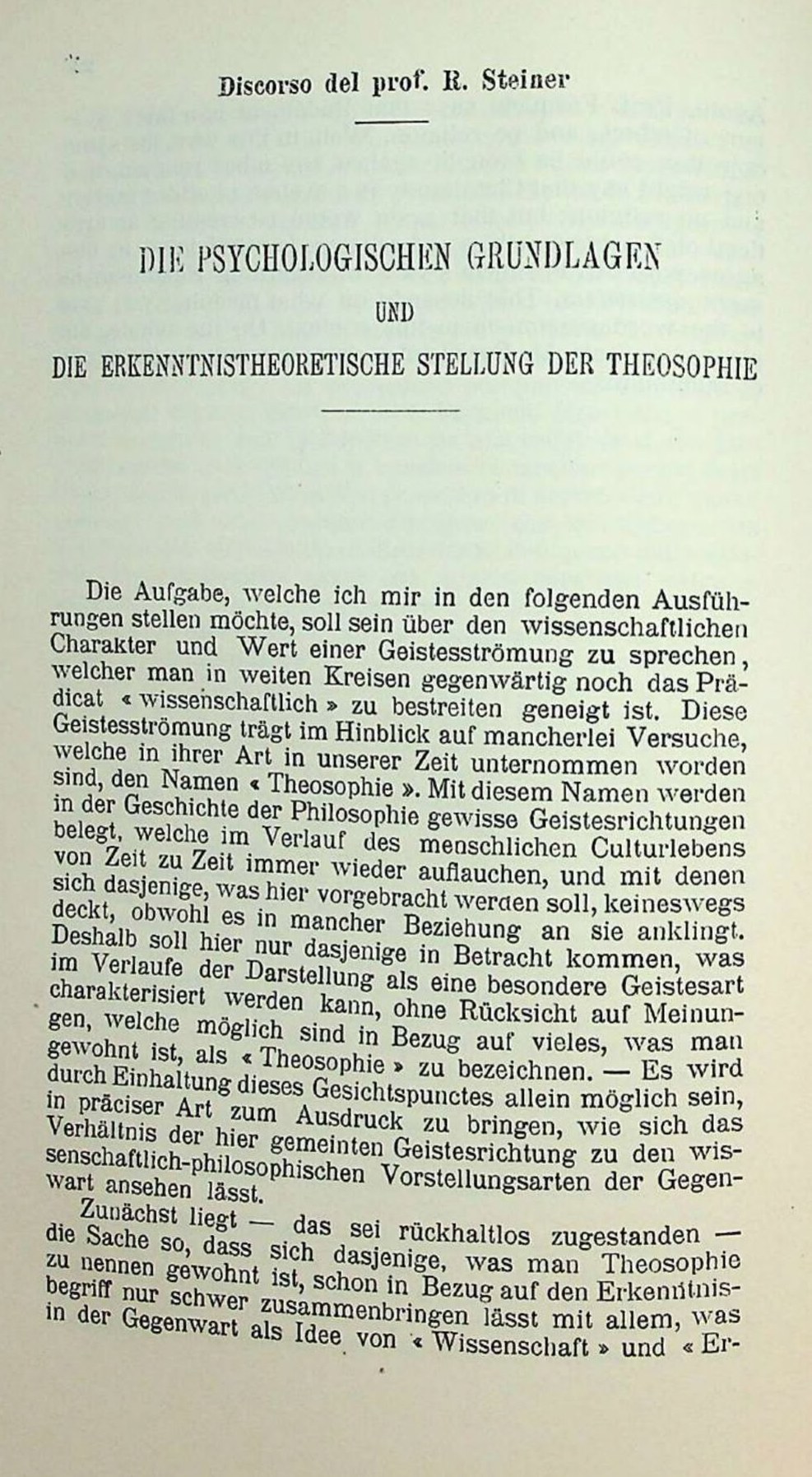
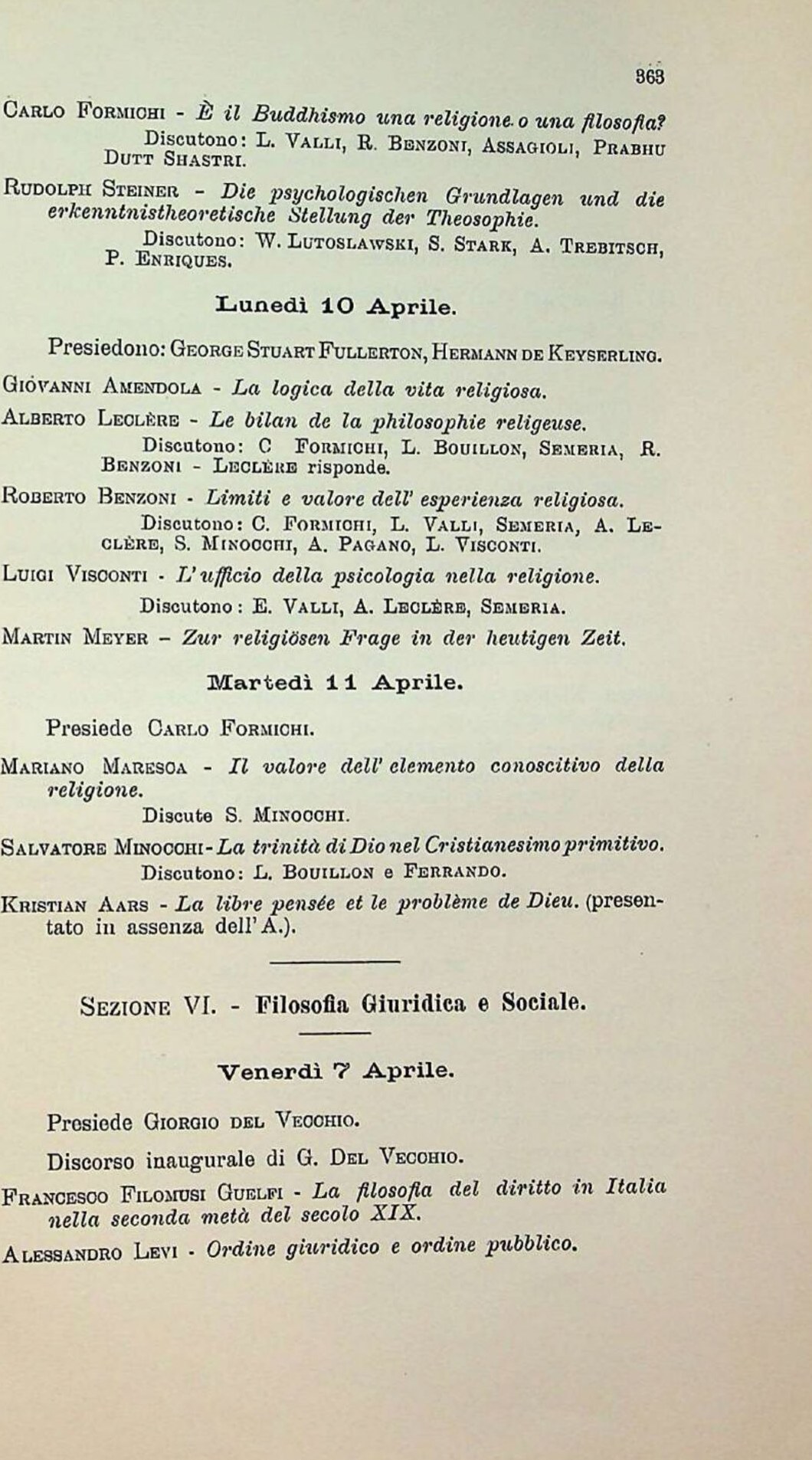
On 8 April 1911, at the 4th International Philosophy Congress in Bologna, Rudolf Steiner addressed an audience of academic philosophers with a revolutionary proposal. He presented an epistemological insight so radical that he himself later placed it alongside his Philosophy of Freedom as one of his most significant philosophical contributions.
The central claim: The ‘I’ does not dwell in the body at all. It lives outside the body, in the transcendental realm of spiritual lawfulness – what the Greeks called the Logos. The body serves merely as a mirror, reflecting this activity back to create self-conscious awareness.
This is not metaphor. It is precise philosophical description, grounded in epistemological[2] (theory of knowledge) analysis and confirmed by direct spiritual investigation.
The Problem: Being Locked Inside Ourselves
Since Descartes, Western philosophy has wrestled with what seems an insurmountable divide. On one side: the knowing subject, locked inside consciousness. On the other side: the known object, forever external and separate.
Kant’s Critique of Pure Reason explored this gap rigorously and concluded we can never truly know the “thing-in-itself” (Ding an sich). We have only our representations, our mental constructs, our inner pictures. Consciousness, it seems, cannot jump over itself. The subject and object remain eternally separated.
This philosophical problem isn’t merely academic. It shapes our entire experience of being human in the modern world. We feel:
- Trapped inside our skulls
- Separated from reality by a veil of perception
- Uncertain whether anything we experience is “really real”
- Isolated in our subjectivity
The existential loneliness of modern consciousness flows directly from this epistemological assumption: that the ‘I’ dwells inside, while the world remains outside, both are separate and religion (re-ligare is latin for: binding back, connecting) serves as a bridge builder, personified figures like the Pope, the pontifex maximus (pons=bridge, facere=to make, maximus=greatest).
Steiner’s Revolutionary Insight
Steiner’s Bologna Lecture dismantles this entire problem by demonstrating that the fundamental premise is false. Here are his own words:
One will arrive at a better conception of the ‘I’ from the viewpoint of the theory of knowledge, not by conceiving the ‘I’ as inside the bodily organisation and receiving impressions ‘from without,’ but by conceiving the ‘I’ as being itself within the law-conformity of things, and viewing the bodily organisation as only a sort of mirror which reflects back to the ‘I’ through the organic bodily activity, the living and moving of the ‘I’ outside the body in the transcendental.
Read that again slowly. Steiner is saying: The ‘I’ is not in here (the body), looking out at a world that is out there (external objects). Rather, the ‘I’ already dwells “out there” – in the lawfulness that gives meaning and structure to all phenomena.
The body doesn’t contain consciousness. The body mirrors consciousness, making it aware of itself.
Understanding what is meant by “Outside the Body”
Here we must be precise. When Steiner says the ‘I’ is “outside the body,” he does not mean:
- Scattered among physical objects in physical space – which is how the term outside in this Lecture is quite often misunderstood or misinterpreted
- Floating around in the air near the body
- Located in some vague “energy field”
Rather, the ‘I’ dwells in what Steiner calls “the transcendental” – the non-spatial realm of spiritual lawfulness that underlies all phenomena – outside and inside. This is:
- The realm of ideas, archetypes, and meaning,
- What the Greeks called the Logos – the divine reason pervading all things
- The dimension of law, principle, and spiritual truth,
- A body-free spiritual world beyond physical space.
Think of it this way: When you grasp a mathematical truth – say, the Pythagorean theorem – where is that truth? It’s not in your brain, which is merely firing neurons. The theorem itself exists in an ideal, non-spatial realm of mathematical laws. And when you understand it, you are participating directly in that realm.
As Steiner says:
The ‘I’, with its mathematical representation, is not outside the transcendental mathematical law-conformity of things but inside this.
Now extend this insight beyond mathematics to all knowing: When you perceive a tree, your ‘I’ is not locked inside your skull, constructing a representation. Your ‘I’ participates in the very lawfulness that manifests as “tree” – the growth principles, the life forces, the archetypal patterns. The body provides a mirror so this participation becomes self-conscious.
That leads to a new insight, that is: Three Realms, not Two
This transforms our ontology[3] entirely. The world is not two realms:
Physical world (matter and body)
Mental world (thought and consciousness)
Rather, we have three:
Physical world – material manifestations
Spiritual lawfulness / Logos – the transcendental realm of ideas, laws, and meaning
Body-as-mirror – reflecting the I’s activity in realm 2, making it conscious
The ‘I’ dwells in the second realm (Logos). When Steiner says the ‘I’ is with the perceived objects, he means it lives in the spiritual lawfulness that underlies and permeates those objects – not in their physical materiality.
This is what makes it “transcendental” – beyond physical space and time, in the eternal realm of spiritual truth.
The Parallel with Roberto Assagioli
This epistemological insight parallels what the Italian psychiatrist Roberto Assagioli (1888-1974) later developed as Psychosynthesis, distinguishing between:
Personal Self – The everyday ‘psychological I’, identified with personality, thoughts, emotions, and body. This feels like it lives “in here.”
Transpersonal Self – The ‘spiritual I’, transcending personality, connected to universal consciousness and higher wisdom. This dwells “beyond” the personal.
Assagioli’s “transpersonal” corresponds with Steiner’s “transcendental” – a dimension beyond embodiment yet more real than physical existence. Both thinkers recognised that our everyday identification of the ‘I’ with the body-brain is a necessary illusion for self-conscious development, but an illusion, nonetheless.
The ‘I’s’ true home is the spiritual realm. The body provides a temporary mirror for self-awareness, like a stage upon which the ‘I’ can observe itself.
Steiner’s 1911 insight anticipated developments in 20th-century phenomenology that would unfold over subsequent decades:
Edmund Husserl (1859-1938)
Husserl, Steiner’s contemporary, developed Phenomenology as the rigorous study of consciousness and its intentional relationship to objects. He recognised that consciousness is always “consciousness of” something – it’s not a closed inner theatre but inherently directed outward.
Husserl’s insight: Consciousness and world are not separate. They arise together in intentionality. To be conscious is already to be in relationship with what is other than consciousness.
This parallels Steiner’s claim that the ‘I’ dwells not inside the body but in its relationship to the lawfulness of things.
The Mirroring of the ‘I’ and The Etheric-body
In the Bologna Lecture, Steiner introduces but does not fully elaborate the physiological mechanism of mirroring. He speaks of the Etheric-body or body of formative forces as the mediating principle:
The Etheric-body rests upon an all-embracing cosmic web of laws; basic in the unification of its action is the tendency to relate itself to something as a centre.
The Etheric-body serves two functions:
Organising physical life – guiding growth, healing, metabolism
Organising soul experiences – transforming spiritual impressions into conscious thoughts
This dual nature makes it the bridge between:
- The transcendental Logos where the ‘I’ dwells
- The Physical-body which mirrors this activity
Steiner demonstrates the mirroring process through the example of memory. When the spiritual researcher learns to observe remembering, it appears as:
First: A subjective turning toward a past experience, like directing one’s gaze spatially but through time. This happens in the etheric realm.
Second: The Physical-body providing resistance – like a reflecting surface – which raises this experience into objective consciousness, making it available as a memory-image.
The past event is not “stored” in the brain like a file in a computer. Rather, the ‘I’ turns toward it in the timeless etheric dimension, and the brain mirrors this turning, producing the experience we call “remembering.”
Note: In later lectures Steiner described this in more detail; we are looking at what Steiner actually presented to the philosophers in Bologna.
The Stages of Spiritual Research
How can one verify this claim? Not through external observation but through the transformation of consciousness itself.
Steiner describes three stages of higher knowledge – not mystical raptures but exact methods of consciousness development:
1. Imagination
Through sustained meditative work with symbolic mental content (what Steiner calls “soul exercises”), consciousness gradually experiences itself independently of the physical body. One begins to perceive the imaginative realm – the sphere where thoughts exist as living forces, not as dead abstractions.
This is like awakening a second kind of vision alongside physical sight. One perceives the formative forces at work in living processes – what Steiner calls the Etheric-organisation.
2. Inspiration
By eliminating even the symbolic content and resting in pure mental activity, consciousness opens to inspiration – direct perception of the spiritual lawfulness underlying phenomena.
Here one experiences not images but the living meaning that permeates reality. This is participation in the cosmic Logos itself – the realm where the ‘I’ truly dwells.
3. Intuition
Through complete self-surrender, the ‘I’ becomes a transparent stage upon which spiritual reality knows itself. The separation between “knower” and “known” dissolves in intuitive cognition – direct participation in the divine self-knowing or co-creation.
These are not vague states but precisely describable transformations of consciousness, pursued with the same rigour a scientist applies to laboratory experiments. The difference: the instrument being refined is consciousness itself.
Implications for Knowledge – or Knowing
This approach transforms everything we think we know about knowing.
Knowledge is not:
- The brain generating representations of external objects
- A subject constructing models of reality
- Consciousness trapped behind a veil of perception
Knowledge is:
- Conscious participation in transcendental lawfulness
- The ‘I’, already dwelling in the Logos, becoming aware of where it is
- The body providing the mirror that makes this participation self-conscious
As Steiner writes:
The ‘I’ – with the whole of a person’s core of being – can be viewed as an entity which experiences its relationship to the objective world within that world itself, and receives its experiences as reflections in the form of impressions from the bodily organisation.
This is not construction but recognition. Not representation but participation. Not isolation but communion with the spiritual ground of reality.
Why This Matters Now
Steiner’s Bologna Lecture addresses what may be the fundamental crisis of modern consciousness: the sense of being trapped inside our skulls, separated from reality, isolated in subjectivity.
This existential isolation drives:
- Philosophical scepticism and nihilism
- Scientific materialism and reductionism
- Psychological alienation and meaninglessness
- Ecological disconnection from nature
- Social fragmentation and loneliness
We suffer from believing we are locked inside, whilst the world remains out there. Steiner’s concept of Participatory Reality, introduced below, offers a way to overcome this challenge.
The Participatory Reality
Steiner’s approach offers the perspective of a participatory reality:
We are not isolated subjects locked in bodily prisons, hopelessly guessing about an external world. We dwell in the heart of reality itself – in the Logos that gives meaning and law to all existence. The body is not our prison but works as our mirror, through which we become self-consciously aware of our true spiritual nature.
This is not consolation but philosophical demonstration, confirmed by:
Epistemological analysis (the Bologna Lecture itself)
Phenomenological convergence (Husserl and others)
Direct spiritual investigation (imagination, inspiration, intuition)
Transpersonal psychology (Assagioli’s psychosynthesis)
The Journey Ahead
Understanding that the ‘I’ dwells in the transcendental Logos-realm rather than the Physical-body opens profound questions:
If I am not my body, what am I?
You are a spiritual being, participating in divine lawfulness, using a physical mirror for self-conscious development.
If consciousness dwells outside the body, what is death?
The removal of the mirror. The ‘I’ continues in the spiritual realm it has always inhabited.
What about reincarnation?
A new mirror for continued development. The ‘I’, dwelling in the eternal realm, periodically embodies to gain new experiences and capacities.
And how do I verify this for myself?
Through the systematic transformation of consciousness described in Steiner’s Knowledge of the Higher Worlds – the practices of imagination, inspiration, and intuition.
These are not matters for belief but for investigation – the patient, rigorous, humble investigation of consciousness itself.
The Bologna Lecture as a Bridge Between Worlds
The Bologna Lecture occupies a unique place in Steiner’s work. Here, speaking to academic philosophers, he built a bridge between:
- Natural science and Spiritual science
- Epistemology (how we know what we know) and Spiritual research
- Ontology (study of being) and Meditative practice (contemplation/meditation)
- Contemporary philosophy and Anthroposophy
- Psychology and Anthroposophy
- Reason and Revelation
The bridge rests on one insight:
The ‘I’ dwells not in the body but in the transcendental realm of spiritual lawfulness – the Logos – whilst the body serves as mirror for self-conscious awareness.
This is not metaphor but precise description.
As you read Steiner’s Bologna Lecture in the pages that follow, hold this question in your awareness:
Where am ‘I’ right now?
Not in your head. Not in your body.
You are in the Logos – the divine lawfulness that permeates all existence.
You have always been there.
The body simply provides the mirror through which you can know yourself.
This recognition changes everything.
Karl-Heinz Finke
Canberra, Australia, January 2026
The Bologna Lecture or
Psychological Foundations of Anthroposophy – Its Standpoint in Relation to the Theory of Knowledge
Source: Rudolf Steiner, GA35 Lecture 2, April 8, 1911, Bologna. In: Esoteric Development, a collection of lectures on Esoteric Development.
Translation: by Olin D. Wannamaker, revised for this article by Karl-Heinz Finke
Edited: by Laura Summerfield using gender inclusive language.
The task which I should like to undertake in the following exposition is that of discussing the scientific character and value of a spiritual trend to which a widespread inclination would still deny the designation “scientific.” This spiritual trend bears – in allusion to various endeavours of its kind in the present period – the name theosophy. In the history of philosophy, this name has been applied to certain spiritual trends which have emerged again and again in the course of the cultural life of humanity, with which, however, what is to be presented here does not at all coincide, although it bears many reminders of them. For this reason, we shall limit our consideration here to what can be described in the course of our exposition as a special condition of the mind, and we shall disregard opinions which may be held in reference to much of what is customarily called theosophy. Only by adhering to this point of view will it be possible to give precise expression to the manner in which one may view the relationship between the spiritual trend we have in mind and the types of conception characterizing contemporary science and philosophy.
Let it be admitted without reservation that, even regarding the very concept of knowledge, it is difficult to establish a relationship between what is customarily called theosophy and everything that seems to be firmly established at present as constituting the idea of “science” and “knowledge,” and which has brought and surely will continue to bring such great benefits to human culture. The last few centuries have led to the practice of recognizing as “scientific” only what can be tested readily by anyone at any time through observation, experiment, and the elaboration of these by the human intellect. Everything that possesses significance only within the subjective experiences of the human mind must be excluded from the category of what is scientifically established. Now, it will scarcely be denied that the philosophical concept of knowledge has for a long time adjusted itself to the scientific type of conception just described. This can best be recognized from the investigations which have been carried out in our time as to what can constitute a possible object of human knowledge, and at what point this knowledge has to admit its limits. It would be superfluous for me to support this statement by an outline of contemporary inquiries in the field of the theory of knowledge. I should like to emphasize only the objective aimed at in those inquiries. In connection with them, it is presupposed that the relationship of the human being to the external world affords a determinable concept of the nature of the process of cognition, and that this concept of knowledge provides a basis for characterizing what lies within the reach of cognition. However greatly the trends in theories of knowledge may diverge from one another, if the above characterization is taken in a sufficiently broad sense, there will be found within it that which characterizes a common element in the decisive philosophical trends.
Now, the concept of knowledge belonging to what is here called anthroposophy is such that it apparently contradicts the concept just described. It conceives knowledge to be something the character of which cannot be deduced directly from the observation of the nature of the human being and their relationship to the external world. On the basis of established facts of the life of the mind, anthroposophy believes itself justified in asserting that knowledge is not something finished, complete in itself, but something fluid, capable of evolution. It believes itself justified in pointing out that, beyond the horizon of the normally conscious life of the mind, there is another into which the human being can penetrate. And it is necessary to emphasize that the life of the mind here referred to is not to be understood as that which is at present customarily designated as the “subconscious.” This “subconscious” may be the object of scientific research; from the point of view of the usual methods in research, it can be made an object of inquiry, as are other facts of the life of nature and of the mind. But this has nothing to do with that condition of the mind to which we are referring, within which the human being is as completely conscious, possesses as complete logical watchfulness over themselves, as within the limits of the ordinary consciousness. But this condition of the mind must first be created by means of certain exercises, certain experiences of the soul. It cannot be presupposed as a given fact in the nature of the human being. This condition of mind represents something which may be designated as a further development of the life of the human mind without the cessation, during the course of this further development, of self-possession and other evidence of the mind’s conscious life.
I wish to characterize this condition of mind and then to show how what is acquired through it may be included under the scientific concepts of knowledge belonging to our age. My present task shall be, therefore, to describe the method employed within this spiritual trend on the basis of a possible development of the mind. This first part of my exposition may be called:
A Spiritual Scientific Mode of Approach Based upon Potential Psychological Facts.
What is here described is to be regarded as experiences of the mind of which one may become aware if certain prerequisite conditions are first brought about in the mind. The epistemological value of these experiences shall be tested only after they have first been simply described.
What is to be undertaken may be designated as a “mental exercise.” The initial step consists in considering from a different point of view contents of the mind which are ordinarily evaluated to their worth as copies of an external item of reality. In the concepts and ideas which the human being forms they wish to have at first what may be a copy, or at least a token, of something existing outside of the concepts or ideas. The spiritual researcher, in the sense here intended, seeks for mental contents which are similar to the concept and ideas of ordinary life or of scientific research; but does not consider their cognitional value in relation to an objective entity, but lets them exist in their mind as operative forces. They plant them as spiritual seed, so to speak, in the soil of the mind’s life, and await in complete serenity of spirit their effect upon this life of the mind. They can then observe that, with the repeated employment of such an exercise, the condition of the mind undergoes a change. It must be expressly emphasized, however, that what really counts is the repetition. For the fact in question is not that the content of the concepts in the ordinary sense brings something about in the mind after the manner of a process of cognition; on the contrary, we have to do with an actual process in the life of the mind itself. In this process, concepts do not play the role of cognitional elements but that of real forces; and their effect depends upon having the same forces lay hold in frequent repetition upon the mind’s life. The effect achieved in the mind depends pre-eminently upon the requirement that the same force shall again and again seize upon the experience connected with the concept. For this reason, the greatest results can be attained through meditations upon the same content which are repeated at definite intervals through relatively long periods of time. The duration of such a meditation is, in this connection, of little importance. It may be very brief, provided only that it is accompanied by absolute serenity of soul and the complete exclusion from the mind of all external sense impressions and all ordinary activity of the intellect. What is essential is the seclusion of the mind’s life with the content indicated. This must be mentioned because it needs to be clearly understood that undertaking these exercises of the mind need not disturb anyone in their ordinary life. The time required is available, as a rule, to everyone. And, if the exercises are rightly carried out, the change which they bring about in the mind does not produce the slightest effect upon the constitution of consciousness necessary for the normal human life. (The fact that – because of what the human being actually is in their present status – undesirable excesses and peculiarities sometimes occur cannot alter in any way one’s judgment of the essential nature of the practice.)
For the discipline of the mind which has been described, most concepts in human life are scarcely at all usable. All contents of the mind which relate in marked degree to objective elements outside of themselves have little effect if used for the exercises we have characterized. In far greater measure are mental pictures suitable which can be designated as emblems, as symbols.
Most fruitful of all are those which relate in a living way comprehensively to a manifold content. Let us take as an example, proven by experience to be good, what Goethe designated as his idea of the “archetypal plant.” It may be permissible to refer to the fact that, during a conversation with Schiller, he once drew with a few strokes a symbolic picture of this “archetypal plant.” Moreover, he said that one who makes this picture alive in his mind possesses in it something out of which it would be possible to devise, through modification in conformity with law, all possible forms capable of existence. Whatever one may think about the objective cognitional value of such a “symbolic archetypal plant,” if it is made to live in the mind in the manner indicated, if one awaits in serenity its effects upon the mind’s life, there comes about something which can be called a changed constitution of mind.
The mental pictures which are said by spiritual scientists to be usable in this connection may at times seem decidedly strange. This feeling of strangeness can be eliminated if one reflects that such representations must not be considered for their value as truths in the ordinary sense, but should be viewed with respect to the manner in which they are effective as real forces in the mind’s life. The spiritual scientist does not attribute value to the significance of the pictures which are used for the mental exercises, but to what is experienced in the mind under their influence.
Here we can give, naturally, only a few examples of effective symbolic representations. Let one conceive the being of the human being in a mental image in such a way that the lower human nature, related to the animal organization, shall appear in its relation to the human being as a spiritual being, through the symbolic union of an animal shape and the most highly idealized human form superimposed upon this – somewhat, let us say, like a centaur. The more pictorially alive the symbol appears, the more saturated with content, the better it is. Under the conditions described, this symbol acts in such a way on the mind that, after the passage of a certain time – of course, somewhat long – the inner life processes are felt to be strengthened in themselves, mobile, reciprocally illuminating one another. An old symbol which may be used with good result is the so-called staff of Mercury – that is, the mental image of a straight line around which a spiral curve. Of course, one must picture this figure as emblematic of a force-system – in such a way, let us say, that along the straight line there runs one force system, to which there corresponds another of lower velocity passing through the spiral. (Concretely expressed, one may conceive in connection with this figure the growth of the stem of a plant and the corresponding sprouting of leaves along its length. Or one may take it as an image of an electro-magnet. Still further, there can emerge in this way a picture of the development of a human being, the enhancing capacities being symbolized by the straight line, the manifold impressions corresponding with the course of the spiral.)
Mathematical forms may become especially significant, to the extent that symbols of cosmic processes can be seen in them. A good example is the so-called “Cassini curve,” with its three figures – the form resembling an ellipse, the lemniscate, and that which consists of two corresponding branches. In such a case the important thing is to experience the mental image in such a way that certain appropriate impressions in the mind shall accompany the transition of one curve form into the other in accordance with mathematical principles.
Other exercises may then be added to these. They consist also in symbols, but such as correspond with representations which may be expressed in words. Let one think, through the symbol of light, of the wisdom which may be pictured as living and weaving in the orderly processes of the cosmic phenomena. Wisdom which expresses itself in sacrificial love may be thought of as symbolized by warmth which comes about in the presence of light. One may think of sentences – which, therefore, have only a symbolic character – fashioned out of such concepts. The mind can be absorbed in meditating upon such sentences. The result depends essentially upon the degree of serenity and seclusion of soul within the symbol to which one attains in the meditation. If success is achieved, it consists in the fact that the soul feels as if lifted out of the corporeal organization. It experiences something like a change in its sense of existence. If we agree that, in normal life, the feeling of the human being is such that their conscious life, proceeding from a unity, takes on a specific character in harmony with the representations which are derived from the percepts brought by the individual senses, then the result of the exercises is that the mind feels itself permeated by an experience of itself not so sharply differentiated in transition from one part of the experience to another as, for example, colour and tone representations are differentiated within the horizon of the ordinary consciousness. The mind has the experience that it can withdraw into a region of inner being which it owes to the success of the exercises, and which was something empty, something which could not be perceived, before the exercises were undertaken.
Before such an inner experience is reached, there occur many transitional stages in the condition of the mind. One of these manifests itself in an attentive observation – to be acquired through the exercise – of the moment of awaking out of sleep. It is possible then to feel clearly how, out of something not hitherto known to one, forces lay hold systematically upon the structure of the bodily organization. One feels, as if in a remembered concept, an after-effect of influences from this something, which have been at work upon the corporeal organization during sleep. And if the person has acquired, in addition, the capacity to experience within their corporeal organization the something here described, they will perceive clearly the difference between the relationship of this something to the body in the waking and in the sleeping state. They cannot then do otherwise than to say that during the waking state this something is inside the body and during the sleeping state it is outside. One must not, however, associate ordinary spatial conception with this “inside” and “outside,” but must use these terms only to designate the specific experiences of a mind which has carried out the exercises described.
These exercises are of an intimate soul-character. They take for each person an individual form. When the beginning is once made, the individual element results from a particular use of the soul to be brought about in the course of the exercises. But what follows with utter necessity is the positive consciousness of living within a reality independent of the external corporeal organization and super-sensible in character. For the sake of simplicity, let us call such a person seeking for the described soul experiences a “spiritual researcher” [Geistesforscher]. For such a spiritual researcher, there exists the definite consciousness – kept under complete self-possession – that, behind the bodily organization perceptible to the senses, there is a super-sensible organization, and that it is possible to experience oneself within this as the normal consciousness experiences itself within the physical bodily organization. (The exercises referred to can be indicated here only in principle. A detailed presentation may be found in my book, Knowledge of the Higher Worlds and Its Attainment.)
Through appropriate continuation of the exercises, the “something” we have described passes over into a sort of spiritually organized condition. The consciousness becomes clearly aware that it is in relationship with a super-sensible world in a cognitional way, in a manner similar to that in which it is related through the senses to the sense world. It is quite natural that serious doubt at once arises, regarding the assertion of such a cognitional relationship of the super-sensible part of the being of the human being to the surrounding world. There may be an inclination to relegate everything which is thus experienced to the realm of illusion, hallucination, autosuggestion, and the like. A theoretical refutation of such doubt is, from the very nature of things, impossible. For the question here cannot be that of a theoretical exposition regarding the existence of a super-sensible world, but only that of possible experiences and observations which are presented to the consciousness in precisely the same way in which observations are mediated through the external sense organs. For the corresponding super-sensible world, therefore, no other sort of recognition can be demanded than that which the human being offers to the world of colours, tones, etc. Yet consideration must be given to the fact that, when the exercises are carried out in the right way – and, most important, with never relaxed self-possession – the spiritual researcher can discern through immediate experience the difference between the imagined super-sensible and that which is actually experienced; just as certainly as in the sense world once can discern the difference between imagining the feel of a piece of hot iron and actually touching it. Precisely concerning the differences among hallucination, illusion, and super-sensible reality, the spiritual researcher acquires through their exercises a practice more and more unerring. But it is also natural that the prudent spiritual researcher must be extremely critical regarding individual super-sensible observations made by them. They will never speak otherwise about positive findings of super-sensible research than with the reservation that one thing or another has been observed and that the critical caution practiced in connection with this justifies the assumption that anyone will make the same observations who, by means of the appropriate exercises, can establish a relationship with the super-sensible world. Differences among the pronouncements of individual spiritual researchers cannot really be viewed in any other light than the different pronouncements of various travellers who have visited the same region and who describe it.
In my book, Knowledge of the Higher Worlds and Its Attainment, that world which, in the manner described, appears above the horizon of consciousness has been called – in accordance with the practice of those who have been occupied as spiritual researchers in the same field – “the imaginative world.” But one must dissociate from this expression, used in a purely technical sense, anything suggesting a world created by mere “fancy.” Imaginative is intended merely to suggest the qualitative character of the content of the mind. This mental content resembles in its form the “imaginations” of ordinary consciousness, except that an imagination in the physical world is not directly related to something real, whereas the imaginations of the spiritual researcher are just as unmistakably to be ascribed to a super-sensibly real entity as the mental picture of a colour in the sense world, for instance, is ascribed to an objectively real entity.
But the “imaginative world” and the knowledge of it mark only the first step for the spiritual researcher, and very little more is to be learned through it about the super-sensible world than its external side. A further step is required. This consists in a further deepening of the life of the soul than that which has been considered in connection with the first step. Through intense concentration upon the soul life, brought about by the exercises, the spiritual researcher must render themselves capable of completely eliminating the content of the symbols from their consciousness. What they then still have to hold firmly within their consciousness is only the process to which their inner life was subjected while they were absorbed in the symbols. The content of the symbols pictured must be cast out in a sort of real abstraction and only the form of the experience in connection with the symbols must remain in the consciousness. The unreal symbolic character of the forming of mental images – which was significant only for a transitional stage of the soul’s development – is thereby eliminated, and the consciousness uses as the object of its meditation, the inner weaving of the mind’s content. What can be described of such a process actually compares with the real experience of the mind as a feeble shadow compares with the object which casts the shadow. What appears simple in the description derives its very significant effect from the psychic energy which is exerted.
The living and moving within the content of the soul, thus rendered possible, can be called a real beholding of oneself. The inner being of the human being thus learns to know itself not merely through reflecting about itself as the bearer of the sense impressions and the elaborator of these sense impressions through thinking; on the contrary, it learns to know itself as it is, without relationship to a content coming from the senses; it experiences itself in itself, as super-sensible reality. This experience is not like that of the ‘I’ when in ordinary self-observation, attention is withdrawn from the things cognized in the environment and is directed back to the cognizing self. In this case, the content of consciousness shrinks more and more down to the point of the “ego.” Such is not the case in the real beholding of the self by the spiritual researcher. In this, the soul content becomes continuously richer in the course of the exercises. It consists in one’s living within law-conforming interrelationships; and the self does not feel, as in the case of the laws of nature, which are abstracted from the phenomena of the external world, that it is outside the web of laws; but, on the contrary, it is aware of itself as within this web; it experiences itself as one with these laws.
The danger which may come about at this stage of the exercises lies in the fact that the person concerned may believe too early – because of deficiency in true self-possession – that they have arrived at the right result, and may then feel the mere after-effects of the symbolic inner pictures to be an inner life. Such an inner life is obviously valueless, and must not be mistaken for the inner life which appears at the right moment, making itself known to true circumspection through the fact that, although it manifests complete reality, yet it resembles no reality hitherto known.
To an inner life thus attained, there is now the possibility of a super-sensible knowledge characterized by a higher degree of certitude than that of mere imaginative cognition. At this point in the soul’s development, the following manifestation occurs. The inner experience gradually becomes filled with a content which enters the mind from without in a manner similar to that in which the content of sense perception enters through the senses from the outer world. Only, the filling of the mind with the super-sensible content consists in an actual living within this content. If one wishes to employ a comparison with a fact taken from ordinary life, it may be said that the entering of the ‘I’ into union with a spiritual content is now experienced as one experiences the entering of the ‘I’ into union with a mental picture retained in memory. Yet there is the distinction that the content of that with which one enters into union cannot be compared in any respect with something previously experienced and that it cannot be related to something past but only to something present. Knowledge of this character may well be called knowledge “through inspiration,” provided nothing except what has been described is associated in thought with this term. I have used the expression thus as a technical term in my book, Knowledge of the Higher Worlds and Its Attainment.
In connection with this “knowledge through inspiration,” a new experience now appears. That is, the manner in which one becomes aware of the content of the mind is entirely subjective. At first, this content does not manifest itself as objective. One knows it as something experienced; but one does not feel that one confronts it. This comes about only after one has through soul-energy condensed it, in a sense, within itself. Only thus does it become something which can be looked at objectively. But, in this process of the psyche, one becomes aware that, between the physical bodily organization and that something which has been separated from this by the exercises, there is still another entity. If one desires names for these things, one may employ those which have become customary in so-called theosophy – provided one does not connect with these names all sorts of fantastic associations, but designates by them solely what has been described. That “something” in which the Self lives as in an entity free from the bodily organization is called the astral body; and that which is discovered between this Astral-body and the physical organism is called the Etheric-body. (One is, of course, not to connect this in thought with the “ether” of modern physics.)
Now, it is from the Etheric-body that the forces come, through which the self is enabled to make an objective perception of the subjective content of inspired knowledge. By what right, it may be asked with good reason, does the spiritual researcher come to the standpoint of ascribing this perception to a super-sensible world instead of considering it a mere creation of their own self? They would have no right to do this if the Etheric-body, which they experience in connection with their psychic process, did not in its inner conformity to law compel them to do so with objective necessity. But such is the case, for the Etheric-body is experienced as a confluence of the all-encompassing complex of laws of the macrocosm. The important point is not how much of this complex of laws becomes the actual content of the spiritual researcher’s consciousness. The peculiar fact is that direct cognition sees clearly that the Etheric-body is nothing else than a compacted image reflecting in itself the cosmic web of laws. Knowledge of the Etheric-body by the spiritual researcher does not at first extend to showing what content from the sum total of the universal cosmic web of laws is reflected by this formation, but to showing what this content is.
Other justifiable doubts which the ordinary consciousness must raise against spiritual research, together with much besides, are the following. One may take note of the findings of this research (as they appear in contemporary literature) and may say: “Actually, what you there describe as the content of super-sensible knowledge proves upon closer scrutiny to be nothing more, after all, than combinations of ordinary conceptions taken from the sense world.” And, in fact, this is what is said. (Likewise, the descriptions of the higher worlds which I myself felt justified in giving in the volumes, Theosophy and Occult Science, an Outline, are found to be, so it seems, nothing but combinations of conceptions taken from the sense world – as, for instance, when the evolution of the Earth through combinations of entities of warmth, light, etc., is described.)
Against this view, however, the following must be said. When the spiritual researcher wishes to give expression to their experiences, they are compelled to employ the means available to sense-conceptions for expressing what is experienced in a super-sensible sphere. Their experience is not to be conceived, then, as if it were like their means of expression, but with the realization that they use this means only like the words of a language which they require. One must seek for the content of their experience, not in the means of expression – that is, not in the illustrative representations – but in the manner in which they use these instruments of expression. The difference between their presentation and a fantastic combining of sensible representations lies in the fact that fantastic combining arises out of a subjective arbitrariness, whereas the presentation of the spiritual researcher rests upon a conscious familiarity with the super-sensible complex of laws, acquired through practice. Here, however, the reason is also to be found why the presentations of the spiritual researcher may so easily be misunderstood. That is, the manner in which they speak is more important than what they say. In the how is reflected their super-sensible experience. If the objection is raised that, in this case, what the spiritual researcher says has no direct relationship with the ordinary world, it must be emphasized in reply that the manner of their presentation does, in fact, meet the practical requirements for an explanation of the sense world drawn from a super-sensible sphere, and that the understanding of the world process perceptible to the senses is aided by real attention to the findings of the spiritual researcher.
Another objection may be raised. It may be asked what the assertions of the spiritual researcher have to do with the content of ordinary consciousness, since this consciousness, it may be said, cannot subject them to testing. Precisely this latter statement is, in principle, untrue. For research in the super-sensible world, for discovering its facts, that condition of mind is necessary which can be acquired only by means of the exercises described. But this does not apply to the testing. For this purpose, when the spiritual researcher has communicated their findings, ordinary unprejudiced logic is sufficient. This will always be able to determine in principle that, if what the spiritual researcher says is true, the course of the world and of life as they proceed before the senses becomes understandable. The opinion which may be formed at first concerning the experiences of the spiritual researcher is not the important point. These may be viewed as hypotheses, regulative principles (in the sense of Kantian philosophy). But if they are simply applied to the sense world, it will be seen that the sense world confirms in the course of its events everything which is asserted by the spiritual researcher. (Naturally, this is valid only in principle; it is obvious that, in details, the assertions of so-called spiritual researchers may contain the gravest errors.)
Another experience of the spiritual researcher can come about only provided the exercises are carried still further. This continuation must consist in the fact that the spiritual researcher, after having attained to beholding the self, shall be able by energetic power of will to suppress this experience. They must be able to free the mind from everything that has been achieved through the continued after-effects of their exercises resting upon the outer sense world. The symbol-images are combined out of sense-images. The living and moving of the self within itself in connection with achieved inspired knowledge is, to be sure, free from the content of the symbols, yet it is a result of the exercises which have been carried out under their influence. Even though the inspired knowledge thus brings about a direct relationship of the self to the super-sensible world, the clear beholding of the relationship can be carried still further. This results from the energetic suppression of the self-view which has been attained. After this suppression, the self may, as one possibility, be confronted by a void. In this case the exercises must be continued. As a second possibility, the self may find that it is more immediately in the presence of the super-sensible world in its real being than it had been in connection with inspired knowledge. In the latter experience, there appears only the relationship of a super-sensible world to the self; in the case of the kind of knowledge we are now describing the self is completely eliminated. If one wishes an expression adapted to ordinary consciousness for this condition of mind, it may be said that consciousness now experiences itself as the stage upon which a super-sensible content, consisting of real being, is not merely perceived but perceives itself. (In the volume, Knowledge of the Higher Worlds and Its Attainment, I have called this kind of knowledge “intuitive knowledge,” but in connection with this expression the ordinary term intuition must be disregarded – which is used to designate every direct experience of a content of consciousness through feeling.)
Through intuitive knowledge, the whole relationship in which the human being as “soul” finds themselves with respect to their bodily organization is altered for the direct observation of the inner being of the soul. Before the faculty of spiritual vision, the Etheric-body appears, in a sense, as a super-sensible organism differentiated within itself. And one recognizes its differentiated members as adapted in a definite way to the members of the physical bodily organization. The Etheric-body is experienced as the primary entity and the Physical-body as its copy, as something secondary. The horizon of consciousness appears to be determined through the law-conforming activity of the Etheric-body. The coordination of the phenomena within this horizon results from the activity of the differentiated members of the Etheric-body striving towards a unity. The Etheric-body rests upon an all-embracing cosmic web of laws; basic in the unification of its action is the tendency to relate itself to something as a centre. And the image of this uniting tendency is the physical body. Thus, the latter proves to be an expression of the World-Ego, as the Etheric-body is an expression of the macrocosmic web of laws.
What is here set forth becomes clearer if we refer to a special fact of the inner life of the soul. This shall be done with reference to memory. As a result of the freeing of the self from the bodily organization, the spiritual researcher experiences the act of recollecting differently from one with ordinary consciousness. For them, recollecting, which is otherwise a more-or-less undifferentiated process, is separated into partial factors. At first, they sense the attraction toward an experience which is to be remembered, like a drawing of the attention in a certain direction. The experience is thus really analogous to the spatial directing of one’s look toward a distant object, which one has first seen, then turns away from, and then turns toward again. The essential aspect of this is that the experience pressing toward remembrance is sensed as something which has stopped far away within the temporal horizon, and which does not merely have to be drawn up from the depths below in the soul’s life. This turning in the direction of the experience pressing toward remembrance is at first a merely subjective process. When the remembrance now actually occurs, the spiritual researcher feels that it is the resistance of the Physical-body which works like a reflecting surface and raises the experience into the objective world of representations. Thus, the spiritual researcher feels, in connection with the process of remembering, an occurrence which (subjectively perceptible) takes place within the Etheric-body, and which becomes their remembrance through its reflection by the physical body. The first factor in recollecting would give merely disconnected experiences of the self. Through the fact that every remembrance is reflected by being impressed upon the life of the physical body, it becomes a part of the ‘I’ -experiences.
From all that has been said it is clear that the spiritual researcher comes to the point in their inner experience where they recognize that the human being perceptible to the senses is the manifestation of a human being who is super-sensible. They seek for a consciousness of this super-sensible human being, not by way of inference and speculation based upon the world that is directly given, but, on the contrary, by so transforming their own condition of mind that this ascends from the perceiving of the sense-perceptible to real participation in the super-sensible. They arrive in this way at the recognition of a content of soul which proves to be richer, more filled with substance, than that of ordinary consciousness. What this road then leads to further can only be suggested here, of course, since a thorough exposition would require a comprehensive treatise. The inner being of the soul becomes for the spiritual researcher the producer, the builder, of that which constitutes the single human life in the physical world. And this producer manifests in itself that it has – interwoven into its life as realities – the forces, not only of the one life, but of many lives. That which may be considered as evidence of reincarnation, of repeated earthly lives, becomes a matter of actual observation. For what one learns of the inner core of the human life reveals, one might say, the telescoping together of interrelated human personalities. And these personalities can be sensed only in the relationship of the preceding and the succeeding. For one which follows is always manifested as the result of another. There is, moreover, in the relationship of one personality to another no element of continuity; rather, there is such a relationship as manifests itself in successive earthly lives separated by intervening periods of purely spiritual existence. To the observation of the soul’s inner being, the periods during which the core of the human being was embodied in a physical corporeal organization are differentiated from those of the super-sensible existence through the fact that, in the former, the experience of the content of the mind appears as if projected against the background of the physical life; while, in the latter, it appears as merged in a super-sensible element which extends into the indefinite. It has not been the intention to present here anything more concerning so-called reincarnation than a sort of view of a perspective which is opened by the preceding reflections.
Anyone who admits the possibility that the human self may be able to become familiar with the core of being which is super-sensibly visible will also no longer consider it unreasonable to suppose that, after further insight into this core of being, its content is revealed as differentiated, and that this differentiation provides the spiritual view of a succession of forms of existence extending back into the past. The fact that these forms of existence may bear their own time-indications may be seen to be intelligible through the analogy with ordinary memory. An experience appearing in memory bears in its content also its own time-indication. But the real “resurvey in memory” of past forms of existence, supported by rigid self-supervision, is still very remote, of course, from the training of the spiritual researcher which has thus far been described, and great difficulties for the inner soul life tower up on the path before this can be attained in an incontestable form. Nevertheless, this lies on the direct continuation of the path to knowledge which has been described. It has been my desire at first to register here, so to speak, facts of experience in the inner soul-observation. It is for this reason that I have described reincarnation only as one such fact, but this fact can be established also on a theoretical basis. This I have done in the chapter entitled “Karma and Reincarnation” in the book, Theosophy. I undertook there to show that certain findings of modern natural science, if thought out to their conclusion, lead to the assumption of the ideas of reincarnation of the human being.
Conclusion: The total (4-fold) nature of the human being
Regarding the total nature of the human being, we must conclude from what has been said that their essential nature becomes understandable when viewed as the result of the interaction of the four members:
1) the Physical bodily organization;
2) the Etheric-body;
3) the Astral-body;
4) the I (the ‘I’),
which develops in the last-named member and comes to manifestation through the relationship between the central core of the human being and the physical organization. It is not possible to deal with the further articulation of these four life-manifestations of the total human being within the limits of one lecture. Here the intention has been to show only the basis of spiritual research.
Further details I have sought to provide:
- as to the method, in the volume, Knowledge of the Higher Worlds and its Attainment; and
- as to the system, in Theosophy and Occult Science, an Outline.
The Experiences of the Spiritual Researcher and the Theory of Knowledge
The exposition which has been presented will render it clear that anthroposophy, rightly understood, rests upon the foundation of a way of developing the human soul, which is to be rigidly systematized in its character, and that it would be erroneous to suppose that there exists in the condition of mind of the spiritual researcher anything of the nature of what is ordinarily called at present enthusiasm, ecstasy, rapture, vision, and the like. Misunderstandings arise which may be presented in opposition to anthroposophy precisely through the confusion between the condition of mind here characterized and these other conditions. First, the belief is created through this confusion that there exists in the mind of the spiritual researcher a state of rapture, of being transported beyond self-possession in one’s consciousness, a sort of striving after immediate instinctive vision. But the truth is just the opposite. The condition of mind of the spiritual researcher is even further removed than is ordinary consciousness from what is ordinarily called ecstasy, vision, from every sort of ordinary seer-ship. Even such states of mind as those to which Shaftesbury refers are nebulous inner worlds in comparison with what is striven for by means of the exercises of the genuine spiritual researcher. Shaftesbury finds that by means of the “cold intellect,” without the rapture of the feeling nature, no path can be discovered leading to deeper forms of knowledge. True spiritual research carries with it the whole inner mental apparatus of logic and self-conscious circumspection when it seeks to transfer consciousness from the sensible to the super-sensible sphere. It cannot be accused, therefore, of disregarding the rational element of knowledge. It can, however, elaborate its contents in concepts through thinking after perception, for the reason that, in passing out of the sense world, it always carries with it the rational element and always retains it, like a skeleton of the super-sensible experience, as an integrating factor of all super-sensible perception.
Naturally, it is impossible here to show the relationship of spiritual research to the various contemporary trends in theories of knowledge. The effort will be made by means of a few rather sketchy observations, therefore, to point out that particular conception of the theory of knowledge and its relationship to spiritual research which must experience the greatest difficulties in relation to spiritual research. It is, perhaps, not immodest to call attention to the fact that a complete basis for discrimination between philosophy and anthroposophy can be obtained from my two publications, Truth and Science and The Philosophy of Freedom.
To the epistemology of our time, it has become increasingly axiomatic to maintain that there are given in the content of our consciousness only pictures, or even only “tokens” (Helmholtz) of the transcendent-real. It will be needless to explain here how critical philosophy and physiology (“specific sense-energies,” views of Johannes Mueller and his adherents) have worked together to make of such a conception an apparently irrefutable idea. Naive Realism, which views the phenomena within the horizon of consciousness as something more than subjective representations of something objective, was considered in the philosophical development of the nineteenth century to have been invalidated for all time. But from that which lies at the foundation of this conception, there follows almost as a matter of course the rejection of the anthroposophical point of view. From the critical point of view, the anthroposophical viewpoint can be considered only as an impossible leap over the limits of knowledge inherent in the nature of our consciousness. If we may reduce to a simple formula an immeasurably great and brilliant expression of the critical theory of knowledge, it may be said that the critical philosopher sees in the facts within the horizon of consciousness representations, pictures, or tokens, and holds that a possible relationship to a transcendental external can be found only within the thinking consciousness. He holds that consciousness, of course, cannot leap beyond itself, cannot get outside itself, in order to plunge into a transcendental entity. Such a conception, in fact, has within it something that seems self-evident, and yet it rests upon a presupposition which one need only see into in order to refute it. It seems almost paradoxical when one brings against the subjective idealism expressed in the conception just cited the charge of a veiled materialism. And yet one cannot do otherwise. Permit me to render clear by a comparison what can be said here. Let a name be impressed in wax with a seal. The name, with everything pertaining to it, has been transferred by the seal into the wax. What cannot pass across from the seal into the wax is the metal of the seal. For the wax, substitute the soul life of the human being and for the seal substitute the transcendental. It then becomes obvious at once that one cannot declare it impossible for the transcendental to pass over into the impression unless one conceives the objective content of the transcendental as not spiritual, since this passing over of a spiritual content could be conceived in analogy with the complete reception of the name into the wax. To serve the requirement of Critical Idealism, the assumption would have to be made that the content of the transcendental is to be conceived in analogy with the metal of the seal. But this cannot be done otherwise than by making the veiled materialistic assumption that the transcendental must be received into the impression in the form of a materially conceived flowing-across. In the event that the transcendental is spiritual, it is entirely possible that the impression could take this up.
A further displacement in the simple facts of consciousness is caused by Critical Idealism through the fact that it leaves out of account the question of the factual relationship existing between the cognitional content and the ‘I’ . If one assumes a priori that the ‘I’ , together with the content of laws of the world reduced to the form of ideas and concepts, is outside the transcendental, it will be simply self-evident that this ‘I’ cannot leap beyond itself – that is, that it must always remain outside the transcendental. But this presupposition cannot be sustained in the face of an unbiased observation of the facts of consciousness. For the sake of simplicity, we shall here refer to the content of the cosmic web of law in so far as this can be expressed in mathematical concepts and formulae. The inner conformity to law in the relationships of mathematical forms is acquired within consciousness and is then applied to empirical factual situations.
Conclusion
Now, no distinction can be discovered between what exists in consciousness as a mathematical concept when, on the one hand, this consciousness relates its own content to an empirical factual situation, and when, on the other, it visualizes this mathematical concept within itself in pure abstract mathematical thinking. But this signifies nothing else than that the ‘I’ , with its mathematical representation, is not outside the transcendental mathematical law-conformity of things but inside this.
The Nature of the ego or ‘I’ – part of the transcendental
Therefore, one will arrive at a better conception of the ‘I’ from the viewpoint of the theory of knowledge, not by conceiving the ‘I’ as inside the bodily organization and receiving impressions “from without,” but by conceiving the ‘I’ as being itself within the law-conformity of things, and viewing the bodily organisation as only a sort of mirror which reflects back to the ‘I’ through the organic bodily activity the living and moving of the ‘I’ outside the body in the transcendental. If, as regards mathematical thinking, one has familiarized oneself with the thought that the ‘I’ is not in the body but outside it, and that the bodily activity represents only the living mirror, from which the life of the ‘I’ in the transcendental is reflected, one can then find this thought epistemologically comprehensible concerning everything which appears within the horizon of consciousness.
One could then no longer say that the ‘I’ would have to leap beyond itself if it desired to enter the transcendental; but one would have to see that the ordinary empirical content of consciousness is related to that which is truly experienced in the inner life of the human being’s core of being as the mirrored image is related to the real being of the person who is viewing themselves in the mirror.
Through such a manner of conceiving in relation to the theory of knowledge, conflict could be decisively eliminated between natural science, with its inclination toward materialism, and a spiritual research, which presupposes the spiritual. For a right of way should be established for natural scientific research, in that it could investigate the laws of the bodily organization uninfluenced by interference from a spiritual manner of thinking. If one wishes to know according to what laws the reflected image comes into existence, one must give attention to the laws of the mirror. This determines how the beholder is reflected; it occurs in different ways depending on whether one has a plane, concave, or convex mirror. But the being of the person who is reflected is outside the mirror. One could thus see in the laws to be discovered through natural scientific research the reasons for the form of the empirical consciousness, and with these laws nothing should be mixed of what spiritual science has to say about the inner life of the human being’s core of being. Within natural scientific research one will always rightly oppose the interference of purely spiritual points of view. It is natural that, in the area of this research, there is more sympathy with explanations which are given in a mechanistic way than with spiritual laws. A conception such as the following must be congenial to one who is at home in clear natural scientific conceptions: “The fact of consciousness brought about by the stimulation of brain cells does not belong in a class essentially different from that of gravity connected with matter” (Moriz Benedikt).
In any case, such an explanation gives with exact methodology that which is conceivable for natural science. It is scientifically tenable, whereas the hypotheses of a direct control of the organic processes by psychic influences are scientifically untenable. But the idea previously given, fundamental from the point of view of the theory of knowledge, can see in the whole range of what can be established by natural science only arrangements which serve to reflect the real core of the human being. This core of being, however, is not to be located in the interior of the physical organization, but in the transcendental. Spiritual research would then be conceived as the way by which one attains knowledge of the real nature of that which is reflected. Obviously, the common basis of the laws of the physical organism and those of the super-sensible would lie behind the antithesis, being and mirror. This, however, is certainly no disadvantage for the practice of the scientific method of approach from both directions. With the maintenance of the antithesis described, this method would, so to speak, flow in two currents, each reciprocally illuminating and clarifying the other. For it must be maintained that, in the physical organization, we are not dealing with a reflecting apparatus, in the absolute sense, independent of the super-sensible. The reflecting apparatus must, after all, be considered as the product of the super-sensible being who is mirrored in it. The relative reciprocal independence of the one and the other method of approach mentioned above must be supplemented by a third method coming to meet them, which enters into the depths of the problem, and which is capable of beholding the synthesis of the sensible and the super-sensible. The confluence of the two currents may be conceived as given through a possible further development of the life of the mind up to the intuitive cognition already described. Only within this cognition is that confluence superseded.
It may thus be asserted that epistemologically unbiased considerations open the way for rightly understood anthroposophy. For these lead to the conclusion that it is a theoretically understandable possibility that the core of the human being may have an existence free of the physical organization, and that the opinion of the ordinary consciousness – that the ‘I’ is to be considered a being absolutely within the body – is to be adjudged an inevitable illusion of the immediate life of the mind. The ‘I’ – with the whole of the human being’s core of being – can be viewed as an entity which experiences its relationship to the objective world within that world itself, and receives its experiences as reflections in the form of impressions from the bodily organisation. The separation of the human being’s core of being from the bodily organization must, naturally, not be conceived spatially, but must be viewed as a relatively dynamic state of release. An apparent contradiction is then also resolved which might be discovered between what is here said and what has previously been said regarding the nature of sleep. In the waking state the human core of being is so fitted into the physical organization that it is reflected in this through the dynamic relationship to it; in the state of sleep the reflecting ceases. Since the ordinary consciousness, in the sense of the epistemological considerations here presented, is rendered possible only through the reflection (through the reflected representations), it ceases, therefore, during the state of sleep. The condition of mind of the spiritual researcher can be understood as one in which the illusion of the ordinary consciousness is overcome, and which gains a starting point in the life of soul from which it actually experiences the human core of being in free release from the bodily organization. All else which is then achieved through exercises is only a deeper delving into the transcendental, in which the ‘I’ of ordinary consciousness really exists although it is not aware of itself as within the transcendental.
Spiritual research is thus proved to be epistemologically conceivable. That it is conceivable will be admitted, naturally, only by one who can accept the view that the so-called critical theory of knowledge will be able to maintain its dogma of the impossibility of leaping over consciousness only so long as it fails to see through the illusion that the human core of being is enclosed within the bodily organization and receives impressions through the senses. I am aware that I have given only indications in outline in my epistemological exposition. Yet it may be possible to recognize from these indications that they are not isolated notions but grow out of a developed fundamental epistemological conception.
- Roberto Assagioli (27 February 1888 – 23 August 1974) — en.wikipedia.org/wiki/Roberto_Assagioli. ↩
- Epistemology is the Theory of Knowledge, or ‘how we come to know what we think we know’ — en.wikipedia.org/wiki/Epistemology. ↩
- Ontology is the Theory of Being, or what actually is — en.wikipedia.org/wiki/Ontology. ↩
- [Ed.] Published as a web page October 2026; the January 2026 text is unchanged. Lecture source: Rudolf Steiner, GA 35, Lecture 2, 8 April 1911, Bologna; translation by Olin D. Wannamaker, revised for this article by Karl-Heinz Finke; edited by Laura Summerfield using gender-inclusive language.